Tuesday, June 12, 2007

St. Louis Blues, Bessie Smith & Louis Armstrong

Eads Bridge, St. Louis, 1905

St. Louis Blues, Bessie Smith & Louis Armstrong, January 14, 1925

Bessie Smith, vocal
Louis Armstrong, cornet
Fred Longshaw, harmonium (reed organ)

Here is a song that is claimed as a classic in both blues and jazz circles. The song had been written back in 1914 by W. C. Handy, the "father of the blues." It has been recorded many times; this is the classic recording. The musical relationship between Bessie and Louis is one of the most celebrated in American music. Temperamentally they do not seem to have meshed too well; I expect it was because of Bessie Smith's inability to share the stage. Louis Armstrong was used to dominating his performances, but he also played accompaniment to a great many blues singers, and could adjust his personality to other performers. Bessie Smith - I take nothing away from her musicianship here - seems to be the kind of person who was used to center stage. She deserved it. As a performer, she often used accompanists, often of high caliber, but she simply does not need them. In her recordings with Armstrong it is more likely to be Armstrong who gets tied up or plays inappropriately. In any case, their recordings are indeed classic, and deserve careful listening.

Fred Longshaw on the reed organ seems like the odd man out, here. It is not an especially jazzy instrument, but it does lend an old-timey feel to the piece, and he doesn't ruin anything. The recording has become such a standby, its hard to imagine it without this weepy sort of sound.

Introduction 0 - 3

The introduction consists of a single bar with the cornet and harmonium playing a note in unison that increases in dynamics. The organ starts playing and the cornet gradually takes over. This sound gives the recording a churchy sort of feeling.

First 12-bar blues chorus - the A theme 4 - 49

I hate to see the evening sun go down [trumpet fill]
It makes me think I'm on my last go-round. [trumpet fill]

These lyrics (much longer in the original by Handy) are typical in the blues. We recognize the familiar 3-verse stanza (a stanza is the equivalent of a paragraph in verse) in which the second line repeats the first.

The mood is melancholic, both regretful of the past and anxious for the future. The world out there is made to reflect the inner feelings of the speaker - a poetic device common not only to the blues but to both writing and living generally. (The pathetic fallacy is a poetic device similar to this one, in which something from nature is made to seem as if participating in a human emotion, as when Elmore James sings The sky is crying, look at the tears roll down the street.)

Notice how Bessie sings the word sun; that's a blue note.

You can hear how prominently Louis is making his presence felt. This may be a Bessie Smith number, but nobody who listens will fail to notice the trumpet accompanist. In the first fill he expressively belts out six notes - repetition is always a key feature of any music, and repeating the same note has its own particular sort of emphasis - before varying the notes. His responses match Bessie's mournful tone perfectly. Although they are perfect, I get the feeling it is like someone trying to show off how much sadder he is than you.

Second 12-bar blues chorus 50 - 1:32

Felling tomorrow like I feel today
Feeling tomorrow like I feel today
I'll pack my grip and make my getaway.

For my money, as good as these performers are throughout the song, in this verse they mesh perfectly, and its a glorious thing.

16-bar verse in a minor key 1:33 - 2:26

Most blues don't have verses. A verse, typically, is more likely to feature in the kind of song you find on Broadway or Hollywood, and is often left out of recordings (though Ella Fitzgerald, Dawn Upshaw, and other performers make a point of including them). Here, the verse provides significant contrast to the blues choruses, not only having a different form - 16 measures - but also because it modulates to a new new, minor key.

St. Louis woman, wears her diamond ring
Pulls her man around by her apron string
Wasn't for powder and this store-bought hair
The man I love wouldn't go nowhere, nowhere

Evidently, her lover is an easy mark for a loose woman who seems to have come from St. Louis and taken him away.

Third blues chorus, back to major key 2:27 - 3:12

I got them St. Louis blues, just as blue as I can be
He's got a heart like a rock cast in the sea
Or else he would not go so far from me.

The last blues chorus starts immediately after the verse. I can well imagine that Bessie has been both enamored of and annoyed by Louis's horning in on her song from the beginning - he is awfully good, which is by definition a good thing, but if he is that good, he might be wanting to take something away from her own performance. In any case, with this verse his fills seem to demand more space and take more time than necessary, and he plays a little like someone who has dropped something and is trying to pick it up.

Muggles, Louis Armstrong


From the FBI file on Louis Armstrong

Muggles, Louis Armstrong and His Hot Five, Chicago, December 7, 1928.

Louis Armstrong, trumpet, vocal

Fred Robinson, trombone

Jimmy Strong, clarinet

Earl Hines, piano

Mancy Carr, banjo

Zutty Singleton, drums.

Muggles means marijuana, which Louis smoked any time he could get his hands on some; or maybe it refers to a reefer high.

First 12-bar blues chorus 0 - 33

Muggles opens with a piano solo by Earl Hines accompanied by Zutty Singleton on the brushes. The solo is stately and elegant, and peppered with gentle flourishes up and down the scales. One can feel here, and elsewhere, the profound influence Hines had on Teddy Wilson, the pianist for many great Billie Holiday recordings. The feeling Hines evokes here is one of gentle mourning or regret.

Second 12-bar blues chorus 33 - 1:06

Fred Robinson takes the second chorus on trombone with the rhythm section comping. Not much feeling evoked in this chorus, or the next.

Third 12-bar blues chorus 1:07 - 1:41

Jimmy Strong takes the third chorus on clarinet with the rhythm section comping. With a solo like this, I really begin to miss Johnny Dodds.

After ten bars Louis takes over with a 2-bar break at 1:36 to the end of the chorus. To me it sounds almost as if Louis had asked Robinson and Strong to play uninspired solos so that he could come in and take over with the greatest possible dramatic contrast. I doubt it, but that is what it sounds like.

Fourth 12-bar blues chorus 1:42 - 2:12

Louis takes this solo in double time. Everything about it seems to leave the past behind to dwell forever in the here and now, looking around for what comes next. The blues feeling here is one of profound awareness.

Fifth 12-bar blues chorus 2:13 - 2:51

This final chorus redeems the entire recording with an expressively anguished feeling. He is reminiscing here about his old mentor, King Oliver, playing the second-to-last chorus from Oliver's Jazzin' Babies' Blues from 1923. In this way, the recording recalls Weather Bird, which is also based on a 1923 King Oliver original.

Gunther Schuller says,

If Weather Bird results in a draw between the two men, Muggles definitely goes to Armstrong, and is, in fact, one of his greatest flights of imagination. His solo, which occupies the entire last third of the performance, is especially striking coming as it does after two dreary solos by Robinson [trombone] and Strong [clarinet]. As Louis enters on the last two bars of Strong’s slow blues chorus, going abruptly into double time, the phrase soars out like a bird suddenly routed from its nest. The impact of Louis’s entrance constitutes one of the great joyful moments of jazz, and even young players who have no particular affinity for Armstrong’s style are impressed by the daring and modernity of this passage. This is undoubtedly due to its strong rhythmic articulation, again bop-like in character. In fact, this solo is almost entirely rhythmic, with virtually no melody.

Towards the end of the solo, Schuller concludes,

Louis delivers himself of one of his most impassioned statements. Earthy, plaintive, expansively declamatory, weighted down with blue notes—it is the epitome of sophisticated, urban instrumental blues.”

West End Blues, Louis Armstrong

West End Blues, Louis Armstrong and His Hot Five, Chicago, June 28, 1928.

Louis Armstrong, trumpet, vocal

Fred Robinson, trombone

Jimmy Strong, clarinet

Earl Hines, piano

Mancy Carr, banjo

Zutty Singleton, drums.

The West End refers to a New Orleans neighborhood. Louis was born and grew up in New Orleans, much like jazz itself.

You can hear a clarion call in Louis's trumpet from the very first notes - one of the most imitated in jazz - where he does a breathtaking (literally!) free-tempo cadenza that says, basically, here I am, and if you haven't been paying attention until now, you really ought to start doing so. Trumpet calls do that sort of thing, and there has rarely been a more effective one.

Introduction 0 – 15

With this introduction, Louis traverses the register, swooping down and down and down and then up and up and up again to a stratospheric high note that lasts and lasts and lasts and lasts...

The next part begins way up there in the high notes and floats effortlessly down and into the body of the piece. Gunther Schuller points out that this introduction "combines two ideas--the occasionally used opening break...and the extended stop-time chorus--into a cadenza that is free in tempo. Yet despite its rubato freedoms, the introduction is, in retrospect, clearly in double time to the main tempo of the piece." (Schuller, Early Jazz, p. 115). [Rubato refers to the momentary change in tempo created by holding some notes longer than others.] He goes on to characterize the first four notes of the piece:

These four notes should be heard by all people who do not understand the difference between jazz and other music, or those who question the uniqueness of the element of swing. These notes as played by Louis--not as they appear in notation--are as instructive a lesson in what constitutes swing as jazz has to offer. The way Louis attacks each note, the quality and exact duration of each pitch, the manner in which he releases the note--in other words the entire acoustical pattern--present in capsule form all the essential characteristics of jazz inflection. (p. 116)

At the end of the intro the ensemble plays a chord.

First blues chorus 16 – 49

After the virtuoso opening this song settles into the format of a traditional 12-bar blues with five choruses. The first is a trumpet solo assisted by Jimmy Strong on clarinet and Fred Robinson on trombone. Both the clarinet and trombone play sustained notes; the trombone often starts out with a smeared pitch and the clarinet often follows the melodic line set out by the trumpet. Strong’s clarinet is is in the dark, woody style known as chalumeau.

Second blues chorus 50 – 1:24

The second chorus is a trombone solo accompanied by those weird clumping percussion things coming from Zutty Singleton on the drums. Note that the trombone phrases again often begin with a smear. The banjo provides accompaniment.

Third blues chorus 1:25 – 2:00

The third chorus has Louis scat singing in a duet with the clarinet (Jimmy Strong) in call and response pattern.

Here is what Billie Holiday had to say about this solo:

It was the first time I heard anybody sing without using any words… Ba-ba-ba-ba-ba-ba-ba-ba and the rest of it had plenty of meaning for me—just as much meaning as some of the other words that I didn’t always understand. But the meaning used to change, depending on how I felt. Sometimes the record would make me so sad I’d cry up a storm. Other times the same damn record would make me so happy.

Fourth blues chorus 2:01 – 2:31

Then comes Earl Hines's piano chorus, in a marked contrast to the playing of Lil Armstrong from earlier Hot Five recordings. The rhythmic and harmonic contributions Hines provides are both clever and discrete. There is a sense we get here of a performer saying “Listen to me,” which comes out in many jazz performances - never more vividly than with the trumpet call that opens this recording. I think this attitude is fairly typical of any of the good players who found themselves accompanying Louis; he brought out their best, and almost required that they play so they could be heard better—not necessarily louder, but better. I am not sure it works that way for Robinson or Strong, but Hines does seem to respond effectively.

In the first four measures the pianist uses his left hand to chord in a legato style while the right hand improvises little filigree figures. In the second four measures (another ten seconds) Hines changes the style of playing with his right hand (at 2:10), pounding out double time figures. This style is known as the “trumpet style” of the piano, which may derive from his encounter with Louis. In the third four measures Hines returns to those stylish figures he started with.

Fifth blues chorus 2:32 – 2:55

In the final chorus Louis and the ensemble play together. Schuller calls this final chorus "the perfect climax, structurally and emotionally. It can only be described as ecstatic." It starts with the first four measures in a single high b flat note sustained for ten long seconds with enormous emotional power. The second four measures features double-timing. In the third four measures the horns cut out (stop playing) as the piano plays a sequence of chords descending the scale, each struck out forcefully, linked by glissandos

Regarding this recording, Earl Hines is quoted in the Time-Life series (John S. Wilson, author of the notes) as follows:

Now how the ending was going to be we didn't know. We got to the end of it and Louis looked at me and I thought of the first thing I could think of, a little bit of classic thing that I did a long time ago and I did it five times and after I finished that I held the chord and Louis gave the downbeat with his head and everybody hit the chord on the end.

The problem was that not everybody hit the chord at the end the first time. Hines continues, speaking of the drummer:

Zutty [Singleton] had this little clop cymbal ... and he clopped it wrong. So then we had to start all over again... We spent hours in there with the hot wax ... But it was a lot of fun -afterwards. When it first came out, Louis and I stayed by that recording practically an hour and a half or two hours and we just knocked each other out because we had no idea it was gonna turn out as good as it did.

Monday, June 11, 2007

Weather Bird, Louis Armstrong

Weather Bird, Louis Armstrong and Earl Hines, Chicago, December 5, 1928

This duet with Earl Hines is one of the high points of jazz recordings, anticipating elements of the music to come, even decades later. To understand this piece as improvised duet means to gain some awareness of how improvisation works. It is both a self-spur to greater achievement and a competition with others in the band - in this case only the duet partner. Improvisation is a way of composing on the spot, which means you have to know the music very well. Weather Bird was composed by King Oliver, with whom Armstrong recorded it first in 1923, a recording worth listening to for a sense of the leaps and bounds (they seem sometimes like literal leaps and bounds) Armstrong and Hines have taken with the music in only 5 years. You also have to know whoever you are improvising with extremely well - Louis and Oliver were masterful at improvising together, and from this recording you get the impression that both Armstrong and Hines are getting to know each other the way wrestlers or fencers do. The level of invention here is astounding.

Both musicians are young and at the top of their form, both are proud and independent, fully engaged in competition with the other. Each is trying to top the other, and in order to understand the other well enough to do so, each seems to learn from the other as the performance unfolds. This gives the piece something of the excitement of a competition, and contributes to the enormously effective concentration of energy and drive as it builds to a climax.

The form of the piece is sectional, which is the kind of form used for rags and marches. There are ten sections (lets call them choruses) in all: Introduction A B B A Interlude C C C Coda. Each of the sections is 16 measures long, the intro is 4, the coda is 12. There is an interlude of 4 measures between the second A and the first C chorus.

As the piece begins you can hear Earl Hines play a kind of stride rhythm - stride was a popular piano style of the day - but as the piece continues he moves further and further from the notion of his piano as a mere rhythm section for Louis’s trumpet solo. You will hear this as you listen to the first four sections, which have a sort of frame or mirror-like structure: the first A and the first B followed by the second B and the second A. In those repeat sections listen to how Hines pulls away from the dominant rhythm, setting his own pace and tempo.

In fact, throughout this piece both performers establish a unique - and very influential - approach to phrasing. Each plays “across the bar line,” that is, extending their phrases beyond where the bar (measure) would end, propelling them, pushing them out. Stanley Dance, in the notes to the Time-Life series, writes,

Hines and Armstrong were among the first jazz musicians to start playing across the bar line in this fashion. There is no feeling here of what might be called the typewriter approach, in which the players seem to be throwing the carriage back and starting afresh after each two bars.

4-bar Introduction 0 - 4

Louis Armstrong and Earl Hines set up the piece with a brief introduction. We will get used to hearing that final cadence (a cadence is a musical strain that comes to a close) throughout these choruses.

16-bar A Chorus 4 - 22

The pair gets off to a bouncy start, responding almost self-consciously to the music and to each other. Typically, the piano plays accompaniment and carries the rhythm, which Hines does, at least in the beginning. As the chorus progresses we hear him - actually, it takes some practice to listen, even to Earl Hines, when Louis is blowing away on top, but its worth doing - as he begins to pull away from the rhythmic norm, experimenting with various sorts of syncopations. (Syncopation means playing off the beat and is common in jazz.) Louis plays this chorus by experimenting, as it were, with dynamics, so that some parts are bold and brassy, others barely whispered.

16-bar B Chorus 23 - 41

In the B strain Hines continues his rhythmic independence, so that he both propels the music forward and creates interesting disruptions in the flow. You can sense how they are listening and responding to each other here.

16-bar B chorus 42 - 58

Hines takes a piano solo on the second B strain, playing stride for 4 bars then shifting gears with a tremolo, breaking into a new rhythm, a cascading arpeggio (an arpeggio is playing the notes of a chord one after another, going up or down the scale), and some rather fancy effects playing with the contrasts between bass (left hand) and treble (right hand) notes.

16-bar A Chorus 59 - 1:18

Armstrong returns to the duet with the reprise of the A strain. He plays the melody, then plays with the melody, and then just leaves it be and improvises, bringing a dramatic intensity to the high notes in bars 8-9 - at 1:07 - with a run of eighth notes at 1:08-9 (meaning there are 8 notes to the measure).

4-bar Interlude 1:19 - 1:22

After the ABBA part there is an interlude of 4 bars. James McCalla calls this “the polymetric section where you’ll lose the beat.” (McAlla, Jazz: A Listener’s Guide, p. 28). This free rhythm is highly advanced (meaning that it leads the way to the kind of jazz that will come later - fifteen or twenty years later - with be-bop and after). The rhythm also suggests what comes next in the piece itself, the three C choruses where the rhythm and the structure of the piece are gradually broken down.

16-bar C Chorus 1:23 - 1:41

The first C section is a piano solo of 16 bars. Note the right hand (treble noes) tremolo around 1:31-2, and closes with the by-now familiar cadential theme.

16-bar C Chorus 1:42 - 2:00

The second C section opens with a 2 bar break by Armstrong (1:42 - 4) , a duet of six bars, another 2-bar break by the trumpet (1:51-2), and another 6-bar duet, all done as if jousting on a high wire, calling and responding, until closing with that familiar cadence. The phrasing in this chorus is shorter than in earlier choruses

16-bar C Chorus 2:01 - 2:17

The third C section opens with a two bar piano break - at 2:01 - 2:02, reversing the order from the previous chorus - so that now the call-and-response is initiated by Earl Hines with Louis Armstrong in the responsive role. This is followed by a six bar duet, where Hines takes a most unusual break at 2:09 - 11. Armstrong plays around with the familiar cadential material, inaugurating a most unusual coda.

12-bar Coda 2:18 - 2:42

The coda to this piece is far more than just a traditional couple of bars that bring a song to a stomping closure. The trumpet and the piano trade 2 bars each twice, and then trade one bar each, twice. This trading twos and then trading ones (as it were) effectively pulls the piece away from the earlier rhythms. The song, as it were, breaks down, phrase by phrase. The number ends on one of Louis’s characteristic high C’s.


Sunday, June 10, 2007

Savoy Blues, Louis Armstrong


Savoy Blues, Louis Armstrong and His Hot Five, December 13, 1927

Louis Armstrong, trumpet
Kid Ory, trombone
Johnny Dodds, clarinet
Lil Hardin Armstrong, piano
Johnny St. Cyr, banjo
Lonnie Johnson, guitar

One of my personal favorites, this recording has hundreds of little things that set it (and me) off. It might be on in the background so I'm barely paying attention, and then something happens in the music and I start to laugh. Most blues sound pretty much the same from chorus to chorus - at least, you can tell its the same song as the choruses return to the same sort of thing. This one, however, keeps changing, but the changes are all integral and welcome. It is, for me, then, a grateful recording, and one of the glories of American music.

The Savoy Ballroom opened in November, 1927 by the Regal Theater on South Parkway, now Martin Luther King Drive, in Chicago. This number, recorded a month later, celebrates that dance hall. It should not be confused with the much legendary Savoy Ballroom in Harlem.

16-bar verse 0 - 29

The recording opens with a verse of 16-bars, the 4-bar sections clearly distinguishable. Louis' tone is stately, reflective, restrained. Each of the 4 bars is taken a bit differently, introduced by increasingly lively splat notes.

First 12-bar blues chorus 30 - 51

This chorus consists of a series of trombone glissandi with clarinet and trumpet playing in unison. They are arranged in a very orderly fashion so that it becomes very easy - even for me - to follow the chord progression. The first four bars in I are from 30 - 36. The second four bars (the second A) is from 38 - 44; listen for the shift to the IV chord at 38 - 41, in the first two bars of the second A verse, returning to the I chord at 42 - 44. Then at 45 - 48, with the B verse, the chord shifts to V and then back to I at 40 - 51.

4 bar Interlude 52 - 59

The guitar and the banjo take a sweet interlude of four bars to set up the guitar solo in the second blues chorus.

Second 12-bar blues chorus 1:00 - 1:22
Lonnie Johnson takes a solo chorus on guitar. It is flanked by 4-bar interludes, thus setting it off from the other blues choruses. Now is as good a time as any to take note of how different these choruses are, and will be, from each other. Johnson played country blues as well as with jazz bands, and is widely regarded as one of the blues virtuosi.

4 bar Interlude 1:23 - 1:30

Another guitar - banjo interlude takes us to the third blues chorus. These interludes have the effect of slowing the pace of the song, giving it a leisurely, relaxed, delicate sort of feeling. There is no hurry to get on to the next chorus, it will come in time, but meanwhile lets just strum a few chords on our instruments...

Third 12-bar blues chorus 1:31 - 1:51

Louis leads this third chorus, his first solo in the recording, accompanied by the rhythm section. Note the descending arpeggio at 1:40.


Fourth 12-bar blues chorus 1:52 - 2:14
Again Louis takes this chorus, starting out as if it were just an ordinary way to follow one chorus with another, then showing how different he can make it so that by the B verse the song seems to have changed yet again.

Fifth 12-bar blues chorus 2:15 - 2:37

Kid Ory takes this fifth chorus on the trombone with rhythm section accompaniment, taking a break at the end of the chorus, leading with a glissando into the sixth chorus.

Sixth 12-bar blues chorus 2:38 - 2:59

Louis takes this chorus with Ory filling in with glissando between the phrases in a new, almost prancing rhythm, concluding with two bars of trumpet, trombone and clarinet playing six notes in unison at 2:57.

Seventh, final, 12-bar blues chorus 3:00 3:22

Louis swings into the final - out - chorus accompanied by Ory and (for the last time) Dodds. He takes a solo break at the end of the chorus, giving Johnson the final word.

Coda 3:22 - 3:26

Lonnie Johnson finishes it off by strumming a bar, accompanied by St. Cyr on banjo.

This was the last time Johnny Dodds recorded with Louis Armstrong, and so marks the end of an important collaboration. For me, it accounts, in part, at least, for the melancholy feeling of the whole piece. Dodds keeps to a low key performance here, providing accompaniment and harmonies but no solo and very few leads until the last chorus. Goodbye, Johnny...

I'm Not Rough, Louis Armstrong


I'm Not Rough, Louis Armstrong and His Hot Five, December 10, 1925

Louis Armstrong, trumpet, vocals
Kid Ory, trombone
Johnny Dodds, clarinet
Lil Hardin Armstrong, piano
Lonnie Johnson, guitar
Johnny St. Cyr, guitar - banjo

The Hot Fives and Hot Sevens are among the greatest recorded music in America. Generally, as you might expect, the Hot Fives refers to recordings made with five players and Hot Sevens to those made with seven performers. Adding Lonnie Johnson [right] on guitar to the mix made for a terrific addition musically, but changed nothing to the name.

Louis Armstrong is credited with, if not inventing the jazz solo, at the very least bringing it to prominence in jazz performance. In this recording, however, he does not solo on his instrument. He takes a one-chorus vocal solo just after the solo chorus by Lonnie Johnson.

I'm Not Rough is a 12-bar blues consisting of six choruses flanked by an intro and coda. The coda, however, is completely lost in a series of riffs which seems to extend the final B verse of the last chorus rather than move into concluding material.

Intro 0 - 7

Lil Armstrong, Louis's second wife, introduces the song with 4 bars on the piano. You can hear her alternate between the right hand on the upper notes and the left hand keeping the beat on the lower notes. This sort of alternation will continue in the first chorus between trumpet and trombone.

First chorus 8 - 33

A blues song consists, generally, of one blues chorus after another. Each 12-bar chorus is will be both the same as and different from the one preceding it and the ones to follow; similarities will include the standard blues progression. The choruses are linked by turnarounds.

Louis keeps his notes in the call crisp and distinct while Ory on trombone slurs his in response, creating one of the many contrasting elements in the song. Listen to Lonnie Johnson's guitar trilling impressively in the background and Dodds on clarinet weaving in and out

The A phrase is from 8 - 16, the second A from 17 - 25 and the B phrase 26 - 33. In each of the phrases you can pick up the fill at the end of each line, a standard feature of any blues verse. Listen to Armstrong's firm but lively turnaround to the second chorus.

Second chorus 34 - 1:01

The second chorus contrasts with the first by its more leisurely approach, and with a more prominent clarinet voice. In fact, the chorus is punctuated by Johnny Dodds's break which he takes at 50 - 52 - nicely set up by Armstrong in the higher register - as the fill for the second A verse.

Third chorus 1:02 - 1:29

Here Louis plays the melody is a far more recognizable way, so that if you've heard the tune before and recognize the lyrics, you can place where they go. This is possible to do in the earlier choruses, but we are less likely to do so. Lonnie Johnson on guitar responds to his call.

Fourth chorus 1:30 - 1:57

This is Lonnie Johnson's chorus, backed up by Johnny St. Cyr on banjo. It is one of those standout performances so common to the Hot Fives and Sevens sides, though it may not be due - as so many of the others are - to the infectious presence of Louis Armstrong. Lonnie Johnson didn't need Louis to inspire him, and in some ways it seems as if the inspiration here is the other way around. In any case, this solo is both subtle and inventive.

Fifth chorus 1:58 - 2:25

The lyrics do not follow the typical AAB format of most blues lyrics; that is, the second verse does not repeat the first. Also, note that while the first verse displays internal rhyme on bite and right the end rhymes in this chorus are all slant or off: right/time/mind.

A Now, I ain't rough, and I don't bite, but the woman that gets me got to treat me right
A 'Cause I'm crazy 'bout my loving, and I must have it all the time!
B It takes a brownskin woman to satisfy my mind, to satisfy my mind

Lonnie Johnson's accompaniment and fills are wonderful here (listen in particular to how he takes the fill at the end of the second A and how he inserts himself after brownskin woman on the B verse) and Armstrong's singing makes even these lyrics sound heartfelt.

Sixth chorus 2:26 - 3:01

The sixth and last chorus is a bit odd because of the numerous shifts it takes with each 4-bar verse. Dodds opens the chorus with four bars on the clarinet in the chalumeau (low) style; his phrases are punctuated (call-and-response) by Kid Ory on the trombone, sounding a little reedy. For the next four bars Louis picks up the tempo considerably in the out-chorus, up-tempo, double-time style that signals the end of a jazz song. However, the ending, starting with the B verse (the last four bars) takes yet another shift. Here a series of riffs initiated by Armstrong's splat-toned notes finish out the chorus and imperceptibly - to my ears - merge into the 2-bar coda.

This odd ending is assertive, even aggressive - perhaps, one might say, rough. If we say that, then we acknowledge an irony that gives the song additional flavor. In any case, its an infectious song I have always been especially fond of.

Friday, June 08, 2007

Hotter Than That, Louis Armstrong


Hotter Than That, Louis Armstrong and His Hot Five, Chicago, December 13, 1927.

Louis Armstrong, trumpet
Kid Ory, trombone
Johnny Dodds, clarinet
Lil Hardin Armstrong, piano
Johnny St. Cyr, banjo
Lonnie Johnson, guitar


It is impossible to overstate the impact of Louis Armstrong on the art and culture of the 20th century. Although he is one of those important and innovative artists who show up once in a while and transform not just their art but their audiences, like maybe Masaccio or Donatello, most people today know him as the singer of nice songs like What a Wonderful World or Hello Dolly; it is hard for them to get past the clowning or downright buffoonish behavior he sometimes exhibited on stage. My role is not to change people's minds, but to introduce Armstrong in the context of a unit on jazz and blues considered in the humanities, and its a real pleasure to talk about this guy, but even more to listen to his music.

Name of section followed by time in minutes and seconds:

Intro (vamp) 0 - 8

The ensemble - that is, the group playing together - takes the first eight bars of introduction, with Louis Armstrong in the lead - a characteristic place for him in any recording he ever made. A chorus in this piece is 32 bars long, so this intro, sometimes referred to as a vamp, is a quarter the length of a typical chorus.

A1 First chorus 09 - 45

The vamp is followed by the first chorus, which consists of Louis Armstrong’s cornet solo accompanied by the rhythm section, with a break in bars 15-16 (at seconds 25-26).

The rhythm section in a jazz band - as we know - consists of the piano, drums, and stringed instruments like banjo or guitar. Fortunately, this recording does not feature the tuba, which does feature on other wonderful recordings, like Potato Head Blues, for example, but which gives to some pieces from this epoch a sort of a comic sense of an elephant’s lumbering along. The tuba was replaced by the string bass in the late 20s to keep the rhythm section rhythmic. There is no drum in these recordings.

The rhythm section is distinguished from the front line, which is the second of the two parts to the Chicago jazz band. The front line consists of the cornet (later the trumpet), the trombone, the clarinet. As we know, the trumpet (or cornet) usually takes the melody as the trombone and clarinet fill in, but each of these instruments may take a solo - each takes a solo in this recording - while the others fill in.

This chorus ends with a clarinet break (seconds 43-45), meaning that Louis' chorus is 30 bars followed by 2 taken by Johnny Dodds in the break.

Such breaks (you may want to listen to them again) are a consistent feature of Chicago jazz (which actually originated in New Orleans but was played and recorded in Chicago by the mid to late 1920s). In a break the rest of the band cuts out for a few measures while the soloist takes a particularly striking few bars by himself to be then re-joined by the ensemble. A break is a way for a soloist to demonstrate his prowess, and for a band to demonstrate how well they keep time together. In this recording they punctuate the middle and endings of the choruses.

A2 Second chorus 46 – 1:20

The second chorus (again at 32 bars long), opens with the final two bars of the first chorus taken by a Johnny Dodds clarinet break leading into his clarinet solo with rhythm accompaniment. Dodds takes another break, (again at bars 15-16) in the middle of the chorus (1:01 – 1:02) as Louis had done in the first chorus. Dodds is a masterful soloist, almost always worth listening to. It is likely that his playing - this would by typical of any player - improves in recordings he made with Louis Armstrong, who seems to inspire him to great depths of feeling.

Then, just as Dodds on clarinet had taken a break at the end of Armstrong’s chorus, Armstrong takes a break at the end of Dodd’s chorus, only this break turns into a scat vocal (1:18 – 1:20). These breaks at the end of the chorus are compelling transitions to the next chorus, and a nice contrast to the breaks that are usually taken in the middle of the choruses.

A3 Third chorus 1:21 – 1:50

Scat singing - which Louis pioneered in recording with Heebie Jeebies, which became a sensational hit in 1926- is the emotive, wordless singing in which the vocal more closely imitates an instrumental, since there are no words, only vocalizations. If at first this style of singing seems like mindless babble, listen more carefully. Armstrong’s singing style influenced every jazz singer after him, though few had his talent.

Armstrong - as we have come to expect - takes a break in the middle of the chorus, again at bars 15-16, (1:37 – 1:38) and continues scatting to the end of the chorus with another break at 1:55 - 1:58, where he starts to imitate himself growling on a muted trumpet. This introduces a 16-bar interlude in which Louis engages the next soloist, Lonnie Johnson on the guitar, in a call and response duet.

Duet Interlude (or, conceivably, the B chorus) with Louis on scat vocal accompanied by guitar antiphony 1:58 - 2:14

After those three A choruses comes the genial and amazing 16-bar duet interlude (half a chorus) for guitar and voice consisting of alternating 2-bar breaks. Lonnie Johnson, a blues guitarist whose fine playing helps take this song into the pantheon of recorded jazz performances, solos on the bridge. The guitar chorus has a similar form as those previous, with a break at bars 15-16, but not at the end.

James McCalla (Jazz: A Listener’s Guide ) calls attention to a particular feature of this chorus:

Try to sing along in the chorus where his scat is working against the backup rhythm, where he’s singing (or syncopating) in 3 (1 2 3 1 2 3) against their 4 (1 2 3 4 1 2 3 4). Louis comes out at the right place at the right time, and had a good time doing it, thank you; can you follow it?”(p. 29).

Me? No thanks!

Interlude 2:14 – 2:17

After the duet interlude comes a 4-bar piano interlude by Lil Hardin Armstrong, Louis’ second wife, the song's composer.

A4 Fourth and final chorus 2:18 – 2:52

Kid Ory on trombone takes 14 bars with rhythm accompaniment leading to another Armstrong 2-bar break at bars 15 and 16 (2:33 – 2:35). This is followed by 8 bars of ensemble playing with, as usual, Louis in the lead and a 4 bar stop time break by Louis over the rhythm section at 2:45 - 50. This final chorus comes to a close with another 2 bars of the ensemble led by Louis that concludes with a 2 bar break by Lonnie Johnson on guitar at 2:52

Coda 2:53 - 3:00

The piece ends with a coda: two bars of solo guitar, another couple of the trumpet and then a final two bars of solo guitar.

Here is Gary Giddens describing the song:

After an eight-bar introduction, Armstrong revels in the theme, bursting into a break at bar fifteen, the melodic content of which appeared in many guises of the next decade (the Ink Spots sing it on “Java Five”). What should have been Armstrong’s second break (bars thirty-one to thirty-two) functions instead as a relay point to introduce Johnny Dodds. Armstrong in turn takes up the relay from Dodds, only this time he sings a rhythmically devious scat chorus, upping the ante with cross-rhythms in bars sixteen to twenty six—his finest vocal to date. He then sings two-bar exchanges with Johnson’s guitar. . . . A piano transition and trombone solo provide a brief lull before the storming climax, a trumpet break and solo in which Armstrong parses twelve high Cs over seven bars. The pacific conclusion is a reprise of two-bar exchanges between trumpet and guitar (Visions of Jazz, p. 96).


Monday, June 04, 2007

Figural Sculpture in Greek Art

Torso, the Knidia, Praxiteles, 4th C
Torso, Dionysos, 3rd C [not featured on this blog]

Links to Some of the Principal Pieces of Figural Sculpture in Greek Art
(found on my blog)

Dates, as usual, are approximate. Pieces are presented in roughly chronological order.

Male Figures

The Mantiklos Apollo c. 700 - 675 BCE
Ivory Youth c. 640 - 640
The New York Kouros, c. 600 – 575
Kleobis and Biton c. 580 BCE
The Rampin Horseman c. 575 - 550
The Moscophoros c. 570 - 560 BCE
The Anavyssos kouros, c. 520
Fallen Warriors, Aphaia Temple, c. 490, c. 480
The Kritios Boy, c. 480 BCE
The Riace Warriors, c. 475 - 450 BCE
The Apollo, west pediment, Olympia,
The Diskobolos, c. 460 - 450
The Doryphoros, Polykleitos, c. 450 - 440 BCE
The Diadoumenos, Polykleitos, c. 440 BCE
Hermes and Dionysos, Praxiteles, c. 343 BCE
Apollo Sauroktonos, Praxiteles, c. 350 - 275
The Apollo Belvedere, late 4th BCE
Bronze Youth from Antikythera, c. 350 - 330
Apoxyomenos, Lyssipos, c. 330 BCE
The Dancing Faun, 3rd - 2nd C
The Barberini Faun, c. 200 BCE
The Hanging Marsyas, first half 2nd C BCE
The Laocoon Group, c. 160 - 20 BCE
The Belvedere Torso, 2nd - 1st C BCE
The Dying Gaul, c. 230 - 220 BCE
The Gaul Group, c. 230 - 220 BCE


Female Figures

The Nikandre Kore c. 650 BCE
The Auxerre Goddess c. 650 - 625 BCE
The Peplos Kore c. 530 BCE
The Akropolis Kore 594, late 6th C BCE
The Chian Kore, late 6th C BCE
The Aspasia type c. 460 BCE
The Ludovisi Throne c. 460 BCE
The Three Goddesses (Fates), by Pheidias group, c. 438- 432
The Flying Nike, by Paionios, c.420 BCE
Nike Adjusting her Sandal c. 410 - 407 BCE
The Wounded Niobid, late 5th C BCE
The Esquiline Venus, uncertain date, late 5th C BCE
Statuette of a Girl c. 400 BCE
The Venus Genetrix, late 5th C BCE
Maenad, by Skopas, c. 360 BCE
The Aphrodite of Knidos, by Praxiteles, c. 340 - 330 BCE
Marble Head from Chios, by Praxiteles, c. 340 - 330 BCE
Praxitilean Torso c. 650 BCE c. 340 - 330 BCE
Venus of Capua, 4th C BCE
Venus of Arles, 4th C BCE
The Capitoline Aphrodite, 2nd C BCE
The Venus de Medici, 2nd C BCE
The Crouching Aphrodite, after 250, BCE
The Aphrodite of Kyrene, 3rd - 1st C BCE
The Winged Victory of Samothrace c. 250 - 180 BCE
Venus Kallypygos c. 3rd - 1st C BCE
The Three Graces c. 3rd - 1st C BCE
The Aphrodite of Melos c. 2nd C BCE

The Aphrodite of Melos (Venus de Milo)


The Aphrodite of Melos (Venus de Milo)

The most celebrated, or at least the best known, statue from antiquity is this superb Aphrodite, found in the early 1820s. She is commonly called the Venus de Milo.

In the first century BCE, Vitruvius defined the three basic elements of architecture, naming them firmitas, meaning it needs the durability to stand up, utilitas, meaning it needs to be useful to people's needs, and venustas, meaning it should be beautiful. Venustas, then, is the Latin word for beauty. It derives from their name for Aphrodite, Venus, and actually means those qualities we associate with the goddess, principally beauty. This statue, perhaps more than any other, has come to stand for beauty in the Ancient world.

Originally, after installing it in the Louvre, the French thought they had a piece of truly Classical art, that is, from the fifth century BCE. Many were disappointed when the base was retrieved, identifying it as Hellenistic. Well, they said, if its only Hellenistic... Phooey!

No matter. It is, in spite of what many feel about Hellenistic art, really great. Don't just take it from me. Rather than prose on about the piece myself, I will simply excerpt three expert opinions:

“...[A] number of late Hellenistic artists began to reinterpret their models in terms of second-century fashion, which preferred a new image of feminine beauty: a tall, high-waisted figure with narrow shoulders and small head but wide-hipped and full-breasted. The most famous example of this type is celebrated under the name Venus de Milo, a Parian marble statue of Aphrodite, 6 feet 8 inches tall, found on Melos and displayed in the Louvre as an object of the greatest visual interest since 1821. It is believed that the statue derived from a fourth-century model which represented the goddess resting her left foot on the helmet of her divine paramour, Ares, while she gazed at her own lovely image reflected in the furnished surface of his shield, which she held in her hands [Venus of Capua]. Although the figure is still and self-absorbed, the composition disturbs her tranquility. The disposition of her limbs and the shadowed folds of her drapery set up contrary rhythms of conflicting axes, while the suspenseful contrast between soft exposed flesh and slipping drapery heightens the emotional impact and sexual potential of the heroically proportioned goddess. In addition, despite the predominant advantage of a three-quarter view which conveys an impression of the body’s mass, there is a flattening of the central torso which tends to draw the eye to the curving silhouette and away from the plastic volume of the figure” (Richard Brilliant, Arts of the Ancient Greeks, 365).

Within a few years of her discovery in 1820, the Aphrodite of Melos had taken the central, impregnable position formerly occupied by the Medici Venus, and even now that she has lost favor with connoisseurs and archeologists, she has held her place in popular imagery as a symbol, or trade-mark, of beauty. ... It remains true that she is fruitful and robust beyond the other nude Aphrodites of antiquity. If the Medici Venus reminds us of a conservatory, the Aphrodite of Melos makes us think of an elm tree in a field of corn. Yet there is a certain irony in this justification through naturalness, for, in fact, she is of all works of antiquity one of the most complex and the most artful. Her author has not only used the inventions of his own time, but has consciously attempted to give the effect of a fifth-century work. Her proportions alone demonstrate this. Whereas in the Venus of Arles and the Venus of Capua the distance between the breasts is considerably less than from breast to navel, in the Aphrodite of Melos the old equality is restored. The planes of her body are so large and calm that at first we do not realize the number of angles through which they pass. In architectural terms, she is a baroque composition with classic effect, which is perhaps exactly why the nineteenth century placed her in the same category of excellence as Handel’s Messiah and Leonardo da Vinci’s Last Supper (Kenneth Clark, The Nude, 137-8).

Carved from Parian marble in two main pieces (joined at the drapery line) the goddess of love and beauty is presented as taller than human women (6’8”), and as a personification of physical perfection. The less careful working on the left side of the face and torso indicates that the statue was meant to be viewed from a ¾ angle to the right... The body is slightly twisted and the left shoulder raised, with similar contrasting motion conveyed by the outward curve of the right hip and the lifted leg and knee opposite. The torso is carved with careful naturalism and a studied effort to achieve ideal proportions and harmony of line. The total effect is one of refined sensuousness, and enjoyment of bodily beauty; it is firmly kept from being merely sensual, however, for there is no exaggeration or unbalanced emphasis, and the figure’s essential dignity is evident. The goddess’ look is serene and detached. She is aware of her beauty, and rejoices in it, but she maintains an Olympian calm. Here is human beauty sublimated by artistic vision and made an object of esthetic contemplation rather than of sensual appeal. In this it preserves the best traditions of earlier Hellenic art.

The tall body, the relatively small head, and the twisted stance suggest the influence of Lyssipus, but the soft modeling of the flesh is more like Praxiteles’ manner, and the composition as a whole is likely patterned on one of his Aphrodite types. The drapery is not eminently successful. It is rather heavily managed and somewhat artificial, and not well integrated with the figure, having no support except the expedient of the raised knee. (The lost right arm seems to have extended across the body, not holding the garment). Its primary purpose is to set off the smooth flesh by contrast and to provide a sharp division of the statue into equal halves (Schoder, Masterpieces of Greek Art, #68).

Not all appreciate it, of course. The French Impressionist painter Pierre-Auguste Renoir - who knew a thing or two about art - said it reminded him of some big gendarme. It is, indeed, over life-size. However, it looks like no policeman, or police woman, I have ever seen.

Schoder's point above concerning the distinction between esthetic contemplation and sensual appeal is an important one. I am not sure I can agree, however, that the overall effect of the work is based on the sort of sublimation where aesthetics takes priority over sensuality. From the Ludovisi Throne on, it seems, Greek artists have been able to represent the sensuality of the female body. That they have done so in ways that evoke more than mere sensuality, in ways that we might call aesthetic, does not, in any way I can understand, mean that sensuality is, or must be, somehow less important than the more intellectual - refined - aesthetic qualities. It all depends on the way we come to the work, how we see it, what we see it as, what sort of relationships we find, and that sort of thing. Admittedly, if I see the piece mostly as an attractive woman whose garment is about to fall to around her ankles, anticipating the event and, perhaps getting to know her better as a sexual fantasy, I will be responding more to her sensuous qualities than her aesthetic appeal. She is, after all, certainly about sexuality and sexual appeal, and about the body generally, specifically the body - the female body - as exposed to view. These are not, I think, topics that must be sublimated to aesthetics. (Nor, of course, need aesthetics be sublimated to them.)


The Belvedere Torso


The Belvedere Torso

A mind elevated to the contemplation of excellence perceives in this defaced and shattered fragment... the traces of superlative genius, the reliques of a work on which succeeding ages can only gaze with inadequate admiration. - Sir Joshua Reynolds
This fragmentary work may be more celebrated for how it has influenced other artists than for anything else.

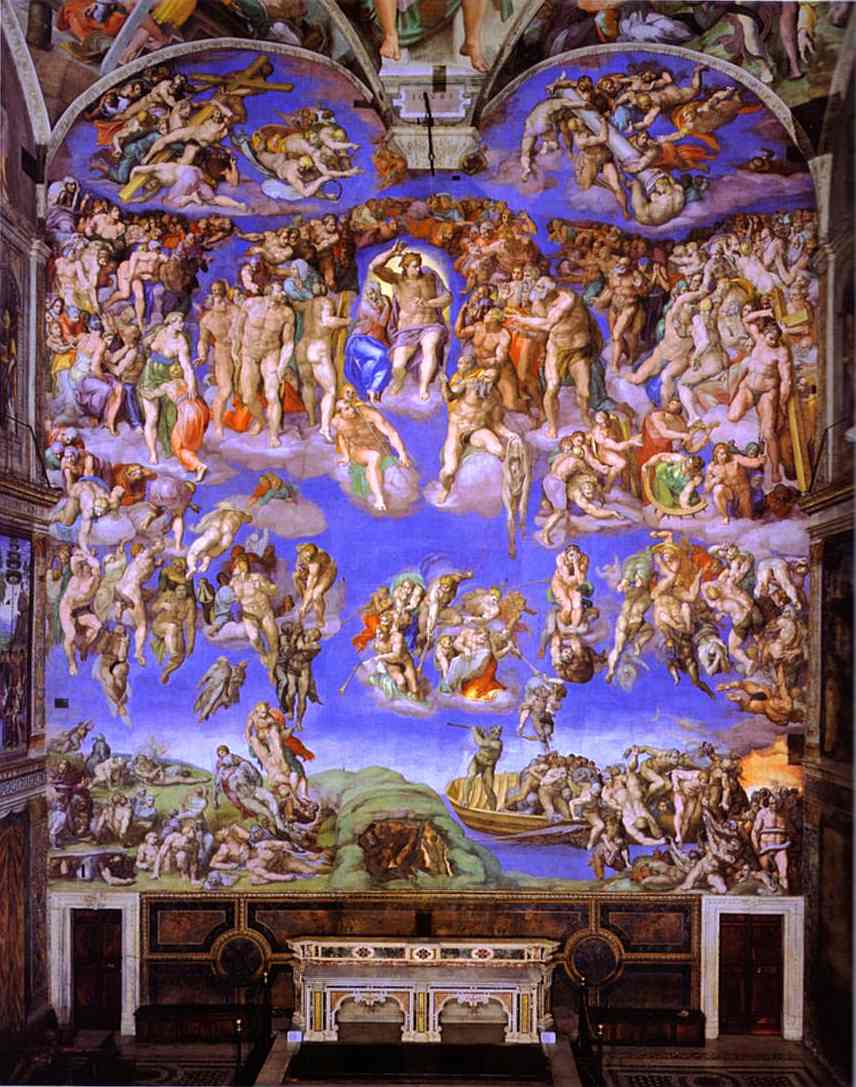
Michelangelo, for one, adopted the pose in his great Last Judgment for the Sistine Chapel for his St. Bartholomew, who was martyred, like Marsyas from Greek myth, by having his skin flayed off. (Marsyas has been suggested as one of the potential models for the Belvedere torso, along with Hercules.)

As a young man, Peter Paul Rubens made an especially fine sketch of this work.

Gaul Killing Himself & The Dying Gaul - the Attalid Monument


Gaul Killing Himself & The Dying Gaul

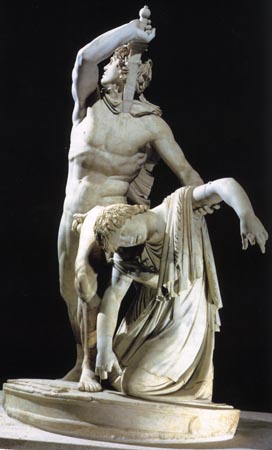
The so-called "Gaul Group" or "Attalid Monument" was a war memorial, apparently consisting of a central statue showing this Gaul about to kill himself, after having just killed his wife to prevent her capture, surrounded by four dying Gauls. The first important point to understand here about the monument itself is that the Gauls were the enemy; here they are portrayed as heroic, noble, and worthy of our attention and sympathy. In this way the monument resembles the Iliad, where the "enemy," the Trojans, are portrayed as heroic and noble and all of that.

The monument is especially important also for its continuation of the effort, found throughout Hellenistic art, to expand the space under consideration. Lysippos began to redefine the sculptural space in the Apoxyomenos. A piece like the Dancing Faun can only be comprehended by walking around it. Here we have a piece - a collection of pieces, really - that can only be fully comprehended by walking through it. Hellenistic art had pioneered the groupings of elements, as spectacularly in the Laocoon; now we the group extended, into the street, as it were. Hellenistic art is especially vivid in its emotionality; here the dead and dying Gauls touch us with raw emotion.

The Dying Gaul - also called The Dying Gladiator - is especially well modeled. As with the Hanging Marsyas, the body itself expresses the pain and suffering - even the hair seems to hurt. It is the same theme as represented in the late Archaic and early Classic sculptures of the Dying Warriors. Here, though, the realism is significantly enhanced, contributing much to the pathos of the scene.

The Gaul Killing Himself is in the shape of a pyramid, though that ordinarily stable form is rendered unstable by a variety of elements, including the basic narrative being expressed. Regrettably, the woman's arm has been restored badly; apparently it should be parallel with her other arm. The 17th Century French painter Nicolas Poussin used the image for a group in the lower left corner of his Rape of the Sabine Women.


The Laocoon Group

Laocoon

The discovery in Rome of this well-known tour-de-force in 1506 confirmed for the Renaissance artists and scholars who flocked to see it what extraordinary achievements had been made by artists from the Classical world. By then, of course, confirmation was hardly needed, but its obvious power struck a chord. It is a compelling masterpiece that exemplifies the passionate glories of art in the Hellenistic period. Titian adopted the motif for one of his own many masterpieces, showing a follower of Bacchus (Dionysos) enrobed with snakes (which were, in any case, associated with that god).

The story is from the Trojan war and tells of the Trojan priest, Laocoon, who learns of the Greek's planned trick with the horse but is prevented by the gods from telling the Trojans what he has learned. Poseidon sends these snaky monsters to devour him and his sons so that the message never gets delivered.

Whatever you find to say about this work is likely to apply to your outlook on Hellenistic art generally. Although it is an acknowledged masterpiece, many people find it excessively emotional and sensational, so that rather than moving and inspiring the viewer we are made to cluck our tongues and shake our heads. Its frontality annoys people who seem to think that such an elaborately conceived work - such a virtuoso performance - ought to make more demands on our involvement with it. It does seem as much like a relief as a sculpture in the round, and when you think about it, the characters do seem posed. So, the argument seems to be, Why isn't it any better than it is?

Here is Winckelmann, the 19th century critic and theorist, with a more positive approach:

Such a soul is depicted in Laocoon’s face—and not only in his face—under the most violent suffering. The pain is revealed in every muscle and sinew of his body, and one can almost feel it oneself in the painful contraction of the abdomen without looking at the face or other parts of the body at all. However this pain expresses itself without any sign of rage either in his face or in his posture. He does not raise his voice in a terrible scream, which Virgil describes his Laocoon as doing (Aeneid I.222); the way in which his mouth is open does not permit it... The pain of body and the nobility of soul are distributed and weighed out, as it were, over the entire figure with equal intensity. Laocoon suffers...; his anguish pierces our very soul, but at the same time we wish that we were able to endure our suffering as well as this great man does... J. J. Winckelmann, Von der Nachahmung der grieschishen Werke in der Maleri und Bildhauerkunst, 1755, p. 21, (transl. E. A. McCormick) [in Brilliant, 359].
On this criterion, I find the Hanging Marsyas a much more effective piece of rhetoric - and it is far more than rhetoric, of course. However, although I find the arguments against this piece interesting, both because I tend to agree with them and because they help me to see it better, I think its conception is truly remarkable and its power is unqualified.

When I consider this work I am not made to contemplate consciousness as such, only the expression of pain and horror. The point here, for me, is that for centuries Greek artists have been exploring aspects of our conscious lives by representing vivid moments at the margins, near death, at critical points of pain and endurance, with ecstatic and erotic moments that seem to reach into us for implications and associations. This work does not do that for me. This work is one of sheer horror. It leaves by the wayside or crowds out any intellectual or religious dimensions, not (I think) for any reason other than the overwhelming nature of the experience.

What this means, then, is that not only are the geometric harmonies implied by Classical Greek art gone, but also the intellectually sustaining presence of mental exploration. This puts the Laocoon into another category of art - not, for me, a lesser one, but a different one. Hellenistic art similarly will often portray nudes more as erotic devices than for any other purpose, which critics find to be jejune or superficial. And often they are.

But when power like this is evoked from stone, I am content to appreciate and admire.

Here is a passage from a recent discussion of art by Denis Young:

...when the editor of the journal Modern Painters, the late Peter Fuller, referring to the classical sculpture of Laocoön and his sons being strangled by serpents, asked historian Grizelda Pollock, "How do we know that Laocoön is supposed to be in pain?" and she replied, "Because we have studied the mode of production prevailing in Greece at the time, and the signifying practice to which it gave rise." "But," said Fuller, "Laocoön is being strangled by a sea monster!" and her response was, "Yes, but just by looking at the sculpture we have no way of knowing he is not enjoying it." Fuller seemed to think that she had thereby reduced her case to absurdity, but many think that she had not. Psychology has shown that although visual forms may be "expressive," it helps to have cues to tell us what they are expressive of (tears of joy, or of sorrow?). I am reminded of an experience I had years ago when, glancing at a muted television, I saw a crowd of obviously Arabic people waving white scarves and dancing in what appeared to be a jubilant parade -- then I turned up the sound and learnt that they were people from the village where President Sadat of Egypt had been born, who were mourning his assassination in a fashion customary to Egypt.
Maybe I am missing something - am I missing something? - but it seems to me that however critical it is to understand modes of production and signifying practices in particular cultures - since these are things audiences learn without being taught and will understand implicitly, so that if we ignore such things in our approach to art we are likely to make significant errors of judgment and understanding - there are some things, like being devoured by snaky monsters, which we are all likely to perceive without too much mediation, and that the artist or artists of the Laocoon group got this. In fact, even if he did not get anything else right, he got this right.

I am here reminded both of the Kuleshov film editing experiments - in which audiences judged identical shots of faces quite differently when juxtaposed with different things they were presumably encountering (the same face would look hungry before a plate of food and sad before a dead person, etc.) - and Darwin's study of facial expressions, enhanced by the work of Paul Ekman and others - which show various universal expressions of emotions. I am not inclined to pursue this here.

Hanging Marsyas


Hanging Marsyas

The story of Marsyas is one of those common to Greek myth in which a contest between a mortal and an immortal ends poorly for the mortal. He is a faun who discovers the flute cast down by Athene in disgust - it makes her face screw up when she plays it, and she would prefer not to look silly, especially when Aphrodite and Hera laugh at her. Perhaps she places a curse on the flute. These, note, are the same three goddesses from the Judgment of Paris, though the myths do not appear to be related.

Marsyas learns how to play - evidently, being a faun, he has no compunction about making his face look odd - and becomes an adept. Regrettably, either he challenges Apollo or Apollo him - I don't know, and I don't think it matters - and they play, at first, to a draw. Apollo, whose instrument is the lyre, then adds his voice, and plays his instrument upside down, no doubt giving later adepts like Charlie Patton or Jimi Hendrix the idea. When Marsyas is unable either to play his instrument upside down or to add his voice, Apollo wins the contest. His prize is to bind Marsyas to a tree and have his flesh stripped off.

The original was apparently a group, consisting, in addition to our Marsyas, a brutal slave preparing to torture the faun and Apollo, sitting around waiting for the show to begin.

The myth of Marsyas, then, becomes the myth of the artist - the suffering artist - who must undergo the most horrible flaying just for plying his trade in a world where competition leads to winners and losers. Marsyas may lose the contest, but he wins the myth. It becomes a favorite subject for artists, and makes for one of Titian's greatest achievements.

The evocation of pain in this piece is done through the attenuated body, with the ribs all sticking out. The face is remarkably placid; he accepts his fate. This is what makes the piece - and the myth - so potent. We feel the pain through the modeling effects on the body. We approach the stoic suffering, the experience of pain and the consciousness of taking it, of rising above it, through our awareness of the contrast between the painful body and the passive, composed face. Marsyas becomes, here, a tragic figure, contrasting, for example, both with the infamous companion piece, a Scythian slave, shown as a brutal, unthinking torturer - right out of central casting, with flat brow and everything - who sharpens the knife that will tear off the faun's flesh, and with the celebrated Laocoon, whose face reflects as much, or more, anguish as his body.

In class discussion, we generally discover the similarities between this piece and representations of the suffering Christ on the cross - Christus patiens - though I doubt if there is a direct link between the two. In the first centuries of Christian art, the cross was rarely used as a motif; Christ's suffering does not become a significant motif until, I think, after the influence of St. Francis.