Showing posts with label Greek Art - Classical. Show all posts

Wednesday, May 23, 2007

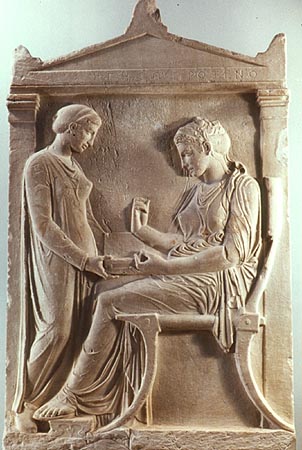
Stele of Hegeso


The Stele of Hegeso, c. 420 BCE

This grave marker commemorates the domestic life of Hegeso, a wealthy woman - wealthy enough in life to have one of her servants hold her jewelry box for her to select something, and in death for someone to pay for this touching, and rewarding, stele. As on the Parthenon frieze and elsewhere, the drapery falls gracefully from the bodies of the two women, and although they are not engaged in any dramatic action, their attention to the little task at hand, and their awareness of one another, is well conceived. The artist engages us by representing the rapt attention of his subjects, so that we become involved in their consciousness. Hegeso's pose suggests to some that she is weary, or regretful - she may be saying farewell to worldly goods - or lost in thought. The stele conveys the abstract quality of her consciousness.

True enough. But I equally prefer finding here a quasi-portrait of the woman - now dead - when she was alive. I think that other-worldliness of her gaze comports well with that interpretation. Selecting jewelry, presumably for some occasion, we are reminded, is not a trivial matter. It is what we do, and it is the kind of thing we pay attention to, when we are alive. The delicacy of gesture, particularly in Hegeso's hand, is memorable (one of the characters refers to it when describing a person in Proust's Within a Budding Grove), and, surely, memorability is the point - its a grave marker, and she is both dead and, if not alive, represented in a lively state of consciousness.

Both of the figures are turned slightly towards the audience - in 3/4 profile - and both of their heads incline towards the center of the composition, where Hegeso's hand creates the center. The sweep of their arms forms a satisfying frame to the upper half of the piece, echoed in the sweep of the chair's legs. They are framed by two simple pilasters and a pediment. ornamented with what would be acroteria in an actual temple. The serving woman's body gently pushes the boundaries of the frame.

Their frame is called an aedicule, or an aedicula. Although the term is usually reserved for similar recesses in a wall, I have found this to be an extremely useful term to identify the common design in which two columns - pilasters, most likely - which support an entablature, frame a vertical rectangular space.

I am especially fond of aedicules and of aediculated designs, and they are ubiquitous in both Classical and Western art.

Wednesday, May 16, 2007

Venus Genetrix


The Venus Genetrix, Roman copy of 5th century original

How hard, or soft, is marble?

The Venus Genetrix is the name given by Julius Caesar to the god he presumed was his ancestor, Venus, who is, of course, the Roman version of Aphrodite. It is probably not the correct name to use for the fifth century sculpture - presumably from the school of Pheidias - of which this is a Roman copy.

Lord Clark points out that while the beauty of the Nike reaching for her sandal - which might be a work of the same artist as here - is incidental, beauty means everything to this sculpture.

Perhaps this was the first Aphrodite, in the sense that the beauty that arouses physical passion was celebrated and given a religious status. ...the subtlest rhythms of the female body are noted with an eager delicacy unsurpassed by Correggio or Clodion. The folds of her drapery flow round the body, but are drawn tight over the breasts and belly, so that the modeling, traversed by one vagrant line, makes its full effect” (Clark, 123).

We have seen these lines before, in the Parthenon pediments, on the parapet of the Temple to Athene Nike, and elsewhere. Here is the quintessence of the rendering of illusionary transparency, where raised ridges substitute for the normally incised channels of the modeling line by which the underlying anatomy of the voluptuous female form is created, revealed, and concealed, by the apparent presence of diaphanous drapery. These lines race around and over the body making elegant filigrees that seem to swoop and swirl with intent.

The discovery of the female nude makes us think. Greek artists have been at work exploring dimensions of human consciousness. They sculpt a number of basic subjects - myths and legends of gods and heroes, athletes and athletic prowess, military victories, offerings to the gods, commemorations of the dead and dying. From the Archaic period (starting around the 8th century BCE) the pieces are highly patterned, and in the next couple of centuries show increasing interest in anatomical details - principally in the male nude kouroi figures. By the Classical era artists are creating figures who seem to come alive, who have a spring in their step, or at least an engaging and rhythmically dynamic stance, so that we notice them more as if they were alive, or intended to represent life, and as if they were moving, or about to move.

Our sculptors have also become fascinated with the sometimes intricate patterns of a dress - in the korai figures of clothed females from the Archaic period - and also in the patterns fabric makes when it drapes the body of a woman reclining, or reaching for her ankle. The anatomy here is modeled not as such but as it becomes revealed. By sculpting clothing in this way, artists find ways to represent qualities of lightness and transparency - the very opposite of the marble or bronze they employ - and to evoke both sensual and temporal feelings in the viewer. These are not just spatial works, but temporal.

I read somewhere - where? Diane Ackerman, perhaps? - that the sense of sight can be thought of as an extension of the sense of touch; we extend our sense of touch spatially, and this doubling up of the senses provides confirmation and the kind of assurances we can only receive from our senses. It is in this context that I see figures such as the Flying Nike of Paionios, the Nike Adjusting Her Sandal, the Wounded Niobid, the Esquiline Venus, the Munich statuette, the Venus Genetrix...

The sensory qualities that get enhanced in our experience of a work like this are rendered somewhat more palpable by the aforementioned sense of time passing which a work like this - and so many from the Classical period onwards - conveys, even in the very subtle modulations of light and shadow that recur among the sinuous folds of the garment.

Statuette of a Girl in Munich


Statuette of a Girl in Munich, c. 400 BCE

Lord Clark points out that she is in the same contrapposto pose as that used by Polykleitos for his nude males:
the weight resting on the right leg, the left bent as if to move; and the girl in Munich is in this attitude. The pose was invented for the male figure, but by one of those happy accidents which often accompany the discoveries of genius, the female figure has drawn it a more lasting profit; for this disposition of balance has automatically created a contrast between the arc of one hip, sweeping up till it approaches the sphere of the breast, and the long, gentle undulation of the side that is relaxed; and it is to this beautiful balance of form that the female nude owes its plastic authority to the present day.

I remember when I first read this passage being struck by the "plastic authority" of the female nude; this was intriguing. Reading this passage, I think, and the one that follows, gave me a much better understanding of how the discovery of contrapposto meant something to artists. Before reading this I might have seen something about how contrapposto provided a way for artists to articulate their forms with a sense of lively energy. Here, I saw for the first time that it was something more than naturalism, that however real the piece might appear, it was more about beauty than about reality, and abstract beauty at that.
The swing of the hip, sweeping up till it approaches the sphere of the breast, and the long, gentle undulation of the side that is relaxed; and it is to this beautiful balance of form that the female nude owes its plastic authority to the present day. The swing of the hip, what the French call the dehanchement, is a motive of peculiar importance to the human mind, for by a single line, in an instant of perception, it unites and reveals the two sources of our understanding. It almost a geometric curve; and yet, as subsequent history shows, it is a vivid symbol of desire. This pose seems obvious enough to us now; yet such are the strange limitations of plastic intelligence that sculptors might have continued for thousands of years, as they did in Egypt and Mesopotamia, without ever discovering it. Yet as soon as it emerged, it became one of the dominant rhythms of humanist art, and carried some evidence of the Greek mental pattern far beyond the confines of Greek philosophy. Every art in which the motive appears has been touched by Hellenistic influence; and although the austere Polykleitos might shudder at the luxurious dehanchements of Amaravati, he is ultimately responsible for them” (Clark,123, 26).

Here, Clark's observations of "plastic intelligence," again struck me as revelatory. It was written far earlier than Howard Gardner's Multiple Intelligences, [pdf] and seemed to take for granted the kind of thing that Gardner - who is very good on the recognition of creativity and artistry - conceived in his research.

Even more interesting, I find, is Lord Clark's positing of our "two sources of understanding" in geometry and desire. How interesting, if true... and also even if not true. I don't think here, though, it is simply a matter of truth; I can decide for myself, I believe, if the two sources of my understanding are going to be based on something like pattern and design or something like hunger and desire. For the moment, I'm thinking, why not?

The Esquiline Venus


The Esquiline Venus


Scholars are uncertain just when she might have been created. Here is how Lord Clark of Civilization describes her:

“...there was produced a bronze figure of a nude girl, perhaps a priestess of Isis, blinding her hair, which must have been a masterpiece. It is known to us in two marble replicas, of which the more complete is the statue in Rome known as the Esquiline Venus, the more vivid the torso in the Louvre. No doubt the original has been changed and elaborated by translation into marble, yet the copies have not lost the unity of the first idea. Somewhere not very far behind them is the work of an individual artist who, on the surviving evidence, must be reckoned the creator of the female nude. Not that the Esquiline girl represents an evolved notion of feminine beauty. She is short and square, with high pelvis and small breasts far apart, a stocky little peasant such as might be found still in any Mediterranean village. Maillol maintained that he could find three hundred in the town of Banyuls alone. Her elegant sisters from the metropolis would smile at her thick ankles and thicker waist. But she is solidly desirable, compact, proportionate, and in fact, her proportions have been calculated on a simple mathematical scale. The unit of measurement is her head. She is seven heads tall, there is a length of one head between her breasts, one from breast to navel, and one from the navel to the division of her legs. More important than these calculations... the sculptor has discovered what we may call the plastic essentials of the female body. Breasts will become fuller, waists narrower, and hips will describe a more generous arc; but fundamentally this is the architecture of the body that will control the observations of classically minded artists till the end of the nineteenth century and has been given fresh life by Maillol in our own day. (Clark, 114-119)

This became an important passage for me as I was learning to explore Greek sculpture, and sculpture in general. I was struck by that business of proportion - which is so important for the classical world, and for so much of art and architecture generally. I had known that underlying both Greek temples and sculptures of the human figure was a system of mathematical relations used by the artists - and likely to have been considered by the artist to possess or illustrate some particularly important quality about the nature of the universe. We think of an artist cocking his head, closing one eye, and looking at things next to his thumb, measuring and comparing things, finding how to represent it somehow.

Here, though, was a consideration of a work of art actually worked out in terms of the head as module to help describe the other parts. This system, which the Greeks imported from Egypt and adopted to their own ways, was instrumental for Greek and classical aesthetics, where Beauty and Geometry (if I may capitalize) were understood to be practically as one.

Proportion is a correspondence among the measures of the members of an entire work, and of the whole to a certain part selected as standard. From this result the principles of symmetry. Without symmetry and proportion there can be no principles in the design of any temple; that is, if there is no precise relation between its members as in the case of those of a well shaped man. -- Vitruvius, The Ten Books of Architecture (III, Ch. 1)

For Vitruvius, the well-shaped man is our familiar Vitruvian man. To some extent, for Polykleitos it was the sort of thing we find in the Doryphoros, whose body is framed out of symmetries and rhythms that are measured and compared; our response to the figure is based - in part - on that chiastic pattern created of these relationships.

And now here comes this Esquiline Venus, or girl, or Queen (possibly Cleopatra?), which I get to see here with the eyes of both Lord Clark and Maillol, that fine 20th century sculptor whose work had been until now more familiar to me than this Greek art. My first female nude sculpture was at the home of my Uncle Henry in Bloomington, Indiana, a fine Maillol which I admired as a kid. Still do, though now I include in my admiration more than plain old wide-eyed lust.

Of course, artists know and learn from the work of other artists; it is not surprising that Maillol would know this piece, and I should have thought of it myself, but now I could see and, I think, feel, something more than, for example, a Rubens drawing of the Hellenistic Belvedere torso had taught me. Even in sculpting from a model, the artist responds to the work of other artists. Duh.
This piece, then, represents the discovery of what Clark calls "the plastic essentials of the female body" and "the architecture of the body." I find I don't respond too well to Clark speaking of an "evolved notion of feminine beauty," but I think he is mostly expressing something about what the Greeks themselves (after Praxiteles, at least) would have felt themselves, and something about the effects of a proportion based on 7:1 (instead of what I remembered was supposed to be the Classical ideal, 8:1).

Maillol maintained that he could find three hundred in the town of Banyuls alone.
I'll bet he could.

I know Banyuls as a French wine I do not drink, probably because it is more than I wish to pay, but also, no doubt, because it is one of those port-like, sweet, fortified wines which if I drink I sometimes wish I hadn't.

Wounded Niobid


Wounded Niobid, late 5th century (?)

Niobe has twelve children, six boys and six girls. This is one of the girls who, along with all of her siblings - the Niobids - are being slaughtered by Leto’s two children, Artemis (for the girls) and Apollo (for the boys). The slaughter avenges the insult Niobe hurled at Leto for only having two children, compared to her own twelve – another instance of human arrogance (and stupidity) in face of the implacable gods.

The theme in this case, however, is neither arrogance nor stupidity, but human pathos.

The arrow from Artemis’ bow has hit her in the back; she has stopped running, started to kneel, throw her head back, and open her mouth in a cry of pain. Her garment has slipped from off her shoulders and is draped ingloriously around her bended thigh. The garment, however, provides stability to the form, as it makes its way from this solid base up and up over the contours of her frame until it reaches the pinnacle created by her elbow on top. It is in the shape, roughly, of a pyramid.

This is an early experiment, then, with the female nude. It is done as narrative art, using the story to convey what the sensation of pain looks like on the female form. This is a beautiful young woman who is in the process of dying. Her death is painful, and as our eyes range over the young woman's charming anatomy we experience with her - almost - her pain, which, like the statue itself, mounts to a crescendo.

The Greeks have never shied away from the theme of dying, but it has been until now, usually, the deaths, rather, of clothed, male soldiers, not scantily draped women. Big difference.


Nike Adjusting Her Sandal, Temple of Athena Nike, Acropolis


Nike Adjusting Her Sandal, Temple of Athena Nike, Acropolis.

Sculptures in stone used a variety of chisels – pointed, flat, and clawed – to chip away at the stone, using hammered blows at various angles to create their effects. The running drill, in use about the 5th century, permitted sculptors to shape finely crafted grooves and channels, thus allowing for some of the more exuberant and expressive drapery effects popular at this time.

The influence of the drapery effects from the Parthenon pediments – those wet or wind-blown looks - may be felt in Greek sculpture – almost literally – throughout the last quarter of the 5th century BCE. The Acropolis was home to several temples, one of which, the Ionic Temple of Athena Nike, was adorned with especially striking reliefs on the parapet showing various Nikes (Nicai, pl for Nike). Sculpture in high relief like this lends itself to especially expressive contrast effects, from deeply cut grooves and the higher swirls they create, and from the contrast of flat with rippled surfaces generally. Modeling lines allow sculptures to create linear patterns in drapery that reveal the lines and shapes of the body beneath.

A catenary is the curve a suspended line makes when hung from equal points; in Greek sculpture it refers to the drapery effect created when a series of such lines are formed by fabric, often falling from the shoulders around the neck and around the breasts. The catenary pattern of parallel lines is an especially pleasing method of giving the drapery the springy qualities of actual fabric and of modeling the human anatomy it both covers and reveals.

This celebrated pose doesn't seem to tell a story or evoke a character or event; its a woman - albeit a Nike, the goddess of victory, reaching down to fix the strap of a sandal, whether tightening or loosening its hard to say. It is as if the sculptor wanted to show off some particularly interesting things he had discovered about the relationship between drapery and the female anatomy, or as if he wanted to create a piece out of a largely elliptical or hyperbolic shapes.

Whatever... The absent head is not missing.

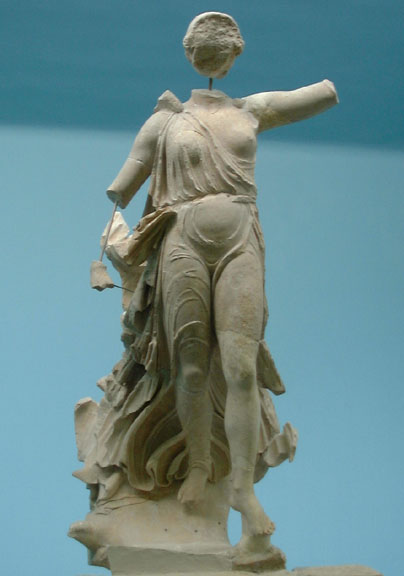
The Flying Nike of Paionios


The Flying Nike by Paionios of Mende, c. 420

How much does stone - marble, say - weigh? Roman copies of Greek bronze originals can come across as heavy in contrast to the bronzes we know of. During the High Classical period of Greek sculpture in the fifth century BCE artists began to recognize methods of making stone seem to weigh less, to weigh almost nothing at all. They were discovering how animated poses help to give a sense of life and energetic motion to stone, a considerable contrast with the still, formal, static poses of Archaic sculpture. The techniques and their effects are visible in this piece, and in a good many fine pieces of sculpture for the rest of the century.

This Flying Nike (Flying Victory) of Paionios graced the top of a tall pillar at Olympia. She is the goddess of victory come from above to commemorate a victory of the Messentians and Naupaktians over Sparta.

She was designed in the popular and beautiful Parian marble - which permits light to penetrate some depth into the surface of the material, and so reflect out of its crystalline interior. She was intended to be seen from below, and to look dramatically in action as she lands on the pillar buoyed by gusts of winds which billow her cloak (himation) about her, providing an expressive, though now largely absent, backdrop of energetic and sustaining motion, as if she was floating down on a sail, or even a parachute. The original was painted. The wind presses the fabric of her chiton up against her body; the physical sensation of the gusting wind sending the fabric coursing all over her body, caressing it even, is intense. The curves and contours of the female form here are nearly fully revealed. Both the woman and the carving appear as exquisite, refined, airy. The American dancer and choreographer Isadora Duncan emulated such drapery effects in some of her dances, and the style became a somewhat tired way of evoking the Classical world.

Kenneth Clark shows how the carving is designed “to bring out rather than to conceal its rotundities.” He is reminded by her body of the early nudes of “Titian or Poussin,” and suggests that the “lack of rhythmic unity” may indicate that the form did not originate with Paionios. He speculates that we might simply have lost those draped nudes that would have demonstrated a more “confident structure.” (Clark, The Nude, 120-1). I have to train my eyes to see what he means – I am not myself professionally trained in art history, all my degrees are in comparative literature. To my eye, if there is something less rhythmically harmonized about her, that very freedom from constraints of form might give the piece some character of its own. Perhaps it anticipates some of the freer or more relaxed qualities of Hellenistic art, coming in a hundred years or so.

Susan Woodford looks at the piece by noting “the characteristic linear formal devices of the late 5th century BC—transparency, modeling lines and, most especially, sweeping motion lines.” (Woodford, 1984, 150). Here are the definitions of those terms from Janet Burnett Grossman’s Looking At Greek and Roman Sculpture in Stone: A Guide to Terms, Styles and Techniques, published by the J. Paul Getty Museum in Los Angeles:

Illusionary transparency creates an impression of a diaphanous fabric for the clothing of a sculpted figure. It was especially popular among sculptors working in the last thirty years of the fifth century B.C. In order to appear like gathered and transparent fabric a successful rendering of illusionary transparency depended on substituting raised ridges for the incised grooves of the modeling line technique to depict drapery. (28)

The modeling line was a method of carving the linear pattern of fabric folds; the incised grooves of the folds of the drapery model the forms of the body it covers... especially common in the drapery figures from the Parthenon Pediments (438/7 – 433/2 B.C.), and it remains important for most of the rest of the fifth century. (26-7)

Motion lines were added to the drapery of a figure to suggest movement. The vertical ridges and valleys of drapery folds swung backward and outward in long serpentine curves, which often ended in complex hemlines. (28)

The Diadumenos - Youth Binding a Fillet - of Polykleitos


The Diadumenos - Youth Binding a Fillet on His Hair - by Polykleitos, c. 440 BCE

Polykleitos, of Doryphoros - Spear-carrier fame, again turns to the portrayal of human proportions, again with a male nude in contrapposto stance. The scene is an athlete binding his brow with the fillet signifying victory. Again, this is no portrait, but rather a portrayal of gently flowing rhythms in contour and line. The chiastic figure created by the contrapposto - where tension and relaxation alternate between left and right in legs, arm, and contour, is made more vivid by the raising of the arms. The pelvis tilts one way, the head and shoulders another, giving this statue the sensation of ordinary movement. It seems as if the accomplishments of the Artemision Zeus and Myron's Diskobolos were in capturing exaggerated poses, but here the artist -Polykleitos - is more focused on the body's response to rather more simple poses, requiring, if anything, more calculation. The chest and thorax here are more lively than in those two earlier works.
As Richard Brilliant says,
Beauty poised in kinetic balance seems to have been the object of Polykleitos' continuing concern for the creation of forms that would reveal the radiant capacities of the human figure, created as idal types without limit of time but present in the world andin space, similar to the figures in the Parthenon metopes and frieze. (Richard Brilliant, Arts of the Ancient Greeks (New York: McGraw-Hill Book Co., 1972) 173-4.

Tuesday, May 08, 2007

The Parthenon Sculptures - East Pediment


The Three Fates, or Three Goddesses, East Pediment Sculptures, The Parthenon

They may be the three Fates - the Moirae, Clotho, Lachesis, Atropos - but it seems unlikely that those grim sisters, spinning, measuring, and cutting the threads of life, would ever convey such a buoyant, engaging spirit; they must be three gods: Hestia, of the hearth, the motherly Dione, and her daughter Aphrodite. The reclining figure is an especially fine response to the somewhat cramped conditions created by the pediment frame.

They are grand women - large, graceful, beautiful. They are arranged informally, as if chatting, Aphrodite leaning on her mother's lap. Perhaps this is the scene, described so cunningly by Homer, when Aphrodite gets her little scratch tended to by her mother.

Aphrodite screamed aloud, and let her son fall, but Phoebus Apollo caught him in his arms, and hid him in a cloud of darkness, lest some Danaan should drive a spear into his breast and kill him; and Diomedes shouted out as he left her, "Daughter of Zeus, leave war and battle alone, can you not be contented with beguiling silly women? If you meddle with fighting you will get what will make you shudder at the very name of war." The goddess went dazed and discomfited away, and Iris, fleet as the wind, drew her from the throng, in pain and with her fair skin all besmirched.
...Aphrodite flung herself on to the lap of her mother Dione, who threw her arms about her and caressed her, saying, "Which of the heavenly beings has been treating you in this way, as though you had been doing something wrong in the face of day?" And laughter-loving Aphrodite answered, "Proud Diomedes, the son of Tydeus, wounded me because I was bearing my dear son Aeneas, whom I love best of all humankind, out of the fight. The war is no longer one between Trojans and Achaeans, for the Danaans have now taken to fighting with the immortals." "Bear it, my child," replied Dione, "and make the best of it. We dwellers in Olympus have to put up with much at the hands of men, and we lay much suffering on one another... (The Iliad, Book 5)

I like to think of these grand goddesses sitting around complaining about how tough their lives are, thanks to mortals.

I find their knees are especially scintillating; see how Hestia, to our left, though sitting, arranges her limbs in quasi-contrapposto fashion, with one leg supporting weight and the other relaxed. All of their limbs are modeled with a superb sense of patterning. The pairs of legs are now revealed, unlike sculpture from the Archaic period. Here the two legs - thighs, knees, ankles and feet - parallel one another, making intriguing echoes. How interesting it becomes to compare one leg with another. What's more, each of these three pairs of legs is conceived as part of an entire design in which three basic patterns of leg placement- seated, folded, and reclining - are explored. Even more striking, of course, is the drapery, and the effects created by those deep, swirling folds in the gowns. These effects are the result of light and shadow as they play out along the sinuous design, giving this group of characters energy and movement which belie their seated or reclining indolence.

The enhanced role of light and shadow in our apprehension of these sculptures somehow makes our viewing of them more - I think - of a personal experience which we feel as individuals. There has to be, in any case, some way of describing the difference between how we react to sculptures from the Classical period such as these and to what came before, in what we call the Archaic. We know the artists knew their art history - as then conceived; they knew their predecessors, sometimes personally, always through their works.

Drapery effects here as elsewhere model the body beneath, so that what conceals also reveals, and the entire effect is captivatingly beautiful. How garments fall and fold themselves over the feminine form has for some time been a keen interest of these artists, working on the kore figure; now an increased boldness arranges the drapery about much more languid and personable characters. Elsewhere, as in the Parthenon frieze, the sculpture of the Classical period can take on abstract qualities. The qualities here are almost exclusively organic, not geometrical. The expressiveness is all, or practically all, and the sense of abundant and glorious femininity is apparent throughout.

These drapery effects are given the generic term "wet drapery," though often we will see the same sort of thing representing a windswept look that conveys force and speed. Here, of course, no wind or water is called for. In their absence, it is as if the engaging force of their conversation were being represented. It seems to call us in. Although I like to think of the artist having a bit of fun with the gods, as above in Homer, I can't help but feel that this artist is involved with the fact of a group of women sitting and talking at home. These drapery effects are nothing if not rhetorical; in the sweep and flow of their garments we may be following the emphases and meanders of talk among women.

Sunday, May 06, 2007

The Parthenon Sculptures - East Pediment


The Horse of Selene, East Pediment, the Parthenon

This is as much of a portrait as I think we ever get from Greek art in the Classic period. The horse is a vivid individual, albeit almost scarily mythological as well. If ever anything was moonstruck it was this horse, one of the two that draw Selene's chariot as she makes her dark way across the sky, following in the nighttime after the daytime passage of her brother Helios - he whose cattle are slain by the luckless crew of Odysseus. Selene, the moon goddess, is here as represented by her nervous horse.

It is, as I say, a true portrait of an exhausted horse, panting and skittish, almost snorting from its extended nostrils, its eyes staring out of its head as its tense muscles draw in tight over the jaw. I think it was originally set at one of the pediment corners - wonderful invention for those tricky spots, if true - and would have, like so much else of the sculptural program, picked up light and developed its ghostly physique from its own shadows. It is a horse Stubbs or Fuseli must have known.

Schoder: The bulging eyes, flaring nostrils, drooping mouth, and pulsing veins under the sagging skin unerringly achieve the effect of weariness, while retaining a sense of the horse’s noble spirit and proud physique.

Parthenon Sculptures - The Frieze


Horses and horsemen, west frieze, Parthenon,

The Parthenon frieze is, for me, the hardest part of the Parthenon sculptures to grasp. Though I have been able to see them up close - thanks, BM! - I have no personal impression to impart, except - again, I am grateful to Pollitt for insights here - that they do seem to be as abstract as Greek sculpture gets. He says, "No two figures are alike; each relates significantly to the others and yet is interesting in itself; the scene has narrative coherence and yet arrests our attention as purely abstract design." The images are not, of course, abstract at all, but their abstract qualities are among their most intriguing.

No one knows for sure what is being represented, though the consensus is the Panathenaic festival, which makes perfect sense. Everybody in Athens participated in this celebration of their patroness goddess - including women - a rare outing for them - but not including slaves. As I gather, the festival would have wound its way around the city, ending up at the Parthenon, where the paraders would find these most satisfying pictures of themselves looking all brave and swirly.

Among the many festivities at this holiday would have been performances of epic tales, including the Homeric material. I think Homer influenced Greek art in ways that can only be imagined, but are so profoundly felt as to feel certain, even if nothing really is. I have little doubt that artists of the Parthenon sculptures were engaged in the Homeric material, its sensory and realistic qualities, its rhetorical sweeps, its memorability, its clarity, and would have felt a kinship to exist between the flurry of excitement they created with light and shadow on stone and that which the rhapsodes created with the sounds of the Homeric line. It all seems a jumble at first, but when you spend time before it, you feel an exuberant sense of pattern and coherence which must have been especially satisfying to the festival participants - and to the artists themselves.

Another something that becomes clear is how much the Greeks love their horses.

Parthenon Sculptures - The metopes


Metope XXVII, The Parthenon, (447-431)

I first learned the term metope in the ordinary sense, I thought, of its role as what alternates with triglyphs to form the visual rhythm of the Doric frieze, the middle element of the entablature in a classical Temple, or architecture based on that model. Sometimes they were left blank, sometimes minor reliefs of, perhaps, animal skulls. The metopes of the Parthenon, however, are major relief sculptures in and of themselves, and though many of them are damaged, those that remain are essential. We learn to look at them both as abstractions - the geometry of the compositions pushes to the fore - and as myth - the Athenians are asserting themselves over mythologized foes.

The Parthenon metopes show the battle known as the Centauromachy, a favorite theme with the Athenians, found, for example, at the earlier Temple of Zeus at Olympia. Here, the age-old struggle between the forces of chaos and those of civilization play out in vivid relief. Both figures are highly expressive in their struggle. I am especially impressed by that left leg, which emerges (to my eye) as much as an abstract diagonal line as a vividly taut leg in violent action. The rest of the piece takes on a general circling motion as the Lapith pulls the Centaur back by the head with his left arm, causing the Centaur to rear expressively. I admire how the artist has managed to keep the Centaur's hoof within the frame, only just, without distortion.

Both figures are impressive and convincing. The fact that both of their heads are gone means that time has treated them with some parallel sense of justice; we know what they are thinking by their bodies rather than their faces. The Centaur has something of a midriff roll, contrasting smartly with the Lapith's leaner physique. Both are modeled so that light and shadow provide emphasis to the rippling forms.

The Lapith's cape is a formidable frame, providing another plane before the flat stone from which the figures emerge - one that holds sway over the action. Although both figures are virtually facing away from each other, they each respond to the other with every fiber of their being.

This metope makes an interesting contrast to the XXXI, which also shows a Lapith battling a Centaur. It is a fine panel, but the Lapith's right hook is awkward, and his chest is far more expressive than his face. The Centaur seems to have recognized what a weak punch that was, and is about to show the Lapith what for. I like what Pollitt has to say: "One wonders if an older sculptor, confronted with the ‘new vision’ of Pheidias’ design, found himself hard-pressed to translate that design into stone."

This metope and others are among the Elgin marbles, taken from Greece to the British Museum for display and safekeeping in the early years of the 19th Century. The Greeks would like them back. Please.

Sunday, April 29, 2007

The Doryphoros - Spear-Carrier - The Canon of Polykleitos


Doryphoros, Polykleitos, 450-440

Galen, [de placitis hippocratis et platonis 5]: “Beauty arises…in the proportion (symmetria) of the parts of the body, such as that of finger to finger, and of all the fingers to the palm and the wrist, and of those to the forearm, and of the forearm to the upper arm, and, in fact, of everything to everything else, just as it is written in the Canon of Polykleitos.

For having taught us in that work all the proportions of the body, Polykleitos supported his treatise with a work of art; that is, he made a statue according to the tenets of his treatise, and called the statue, like the work, the “Canon.”

Galen, [de temperamentis 1.9]: “Modellers and sculptors and painters, and in fact image-makers in general, paint or model beautiful figures by observing an ideal form in each case, that is, whatever form is the most beautiful in man or in the horse or in the cow or in the lion, always looking for the mean within each genus. And a certain statue might perhaps also be commended, the one called the “Canon” of Polykleitos; it got such a name from having precise symmetria of all the parts to one another.”
The loss of so many original Greek bronzes is tough. Those we do possess - the Zeus (Poseidon?) of Artemesion, the Charioteer of Delphi, the Riace Warriors - are, whatever else they are, convincing. In so many cases, however, we are stuck with base Roman copies like this one. Fragments may be tragically incomplete and yet strike us for some quality or other worth noting; often they summon us in spite of their tatters. For most copies, however, we must take an entirely different approach. We are not moved. Nothing especially noteworthy calls our attention until we start reading the work and re-imagining it as quick and vivid and vital and compelling. Instead of being convinced by the work itself, we have to convince ourselves, which is not how it ought to work.

Sigh. But so it goes.

And this, then, is the masterpiece of Polykleitos, the so-called "canon of proportion." The book of that name, by Polykleitos, is, of course, lost, and we can not recover the exact proportions themselves. So, let's take a look. He holds a spear in his left hand and is about to take a step as he looks off to the right. All his weight is supported by the right leg. His right arm is relaxed, his left tense. We begin to pick up a cross-rhythm here, a chiastic pattern in which the tension of the right leg is balanced by the relaxation of the right arm, and the relaxation of the left leg is balanced by the tension of the left arm. It is through the torso we may see how most of the energy is distributed. The contrapposto stance, with that left leg relaxed, extends the contour on this side through the lowered hip. The relaxed line of his left side contrasts with the tension we find on the right, where the hip is raised. And so in the torso here we find a dynamism that animates the entire figure, so that the shifting of axes at both hips and shoulders, combined with the chiastic nature of the limbs and that curious head tilt, give the whole piece life and energy while preserving both rhythmos and symmetria.

Lord Clark calls our attention to the torso [pictured above] based on the Polykeitian canon located at the Uffizi.

The cuirasse esthetique, which so greatly delighted the artists of the Renaissance, is one of the features of antique art that have done most to alienate modern taste. It seems to us ungraceful in itself and completely lacking in vitality. But although a row of formalized torsos in the Galleries of the Vatican or the Naples Museum may not cause the pulse to vary its beat, we can see from certain replicas that this was originally a construction of great power. Such is the copy of the Doryphoros in the Uffizi, which, being in a hard, smooth basalt, conveys the effect of bronze, and is executed with unusual care. It preserves some of the urgency and concentration of the original, and proves that Polykleitos’ scheme of the body, like all abstractions that have survived, not only contained life, but was bursting with a vitality all the more potent because forced into so narrow a channel (Clark, The Nude, 68).