Showing posts with label Greek Art - Hellenistic. Show all posts

Monday, June 04, 2007

The Aphrodite of Melos (Venus de Milo)


The Aphrodite of Melos (Venus de Milo)

The most celebrated, or at least the best known, statue from antiquity is this superb Aphrodite, found in the early 1820s. She is commonly called the Venus de Milo.

In the first century BCE, Vitruvius defined the three basic elements of architecture, naming them firmitas, meaning it needs the durability to stand up, utilitas, meaning it needs to be useful to people's needs, and venustas, meaning it should be beautiful. Venustas, then, is the Latin word for beauty. It derives from their name for Aphrodite, Venus, and actually means those qualities we associate with the goddess, principally beauty. This statue, perhaps more than any other, has come to stand for beauty in the Ancient world.

Originally, after installing it in the Louvre, the French thought they had a piece of truly Classical art, that is, from the fifth century BCE. Many were disappointed when the base was retrieved, identifying it as Hellenistic. Well, they said, if its only Hellenistic... Phooey!

No matter. It is, in spite of what many feel about Hellenistic art, really great. Don't just take it from me. Rather than prose on about the piece myself, I will simply excerpt three expert opinions:

“...[A] number of late Hellenistic artists began to reinterpret their models in terms of second-century fashion, which preferred a new image of feminine beauty: a tall, high-waisted figure with narrow shoulders and small head but wide-hipped and full-breasted. The most famous example of this type is celebrated under the name Venus de Milo, a Parian marble statue of Aphrodite, 6 feet 8 inches tall, found on Melos and displayed in the Louvre as an object of the greatest visual interest since 1821. It is believed that the statue derived from a fourth-century model which represented the goddess resting her left foot on the helmet of her divine paramour, Ares, while she gazed at her own lovely image reflected in the furnished surface of his shield, which she held in her hands [Venus of Capua]. Although the figure is still and self-absorbed, the composition disturbs her tranquility. The disposition of her limbs and the shadowed folds of her drapery set up contrary rhythms of conflicting axes, while the suspenseful contrast between soft exposed flesh and slipping drapery heightens the emotional impact and sexual potential of the heroically proportioned goddess. In addition, despite the predominant advantage of a three-quarter view which conveys an impression of the body’s mass, there is a flattening of the central torso which tends to draw the eye to the curving silhouette and away from the plastic volume of the figure” (Richard Brilliant, Arts of the Ancient Greeks, 365).

Within a few years of her discovery in 1820, the Aphrodite of Melos had taken the central, impregnable position formerly occupied by the Medici Venus, and even now that she has lost favor with connoisseurs and archeologists, she has held her place in popular imagery as a symbol, or trade-mark, of beauty. ... It remains true that she is fruitful and robust beyond the other nude Aphrodites of antiquity. If the Medici Venus reminds us of a conservatory, the Aphrodite of Melos makes us think of an elm tree in a field of corn. Yet there is a certain irony in this justification through naturalness, for, in fact, she is of all works of antiquity one of the most complex and the most artful. Her author has not only used the inventions of his own time, but has consciously attempted to give the effect of a fifth-century work. Her proportions alone demonstrate this. Whereas in the Venus of Arles and the Venus of Capua the distance between the breasts is considerably less than from breast to navel, in the Aphrodite of Melos the old equality is restored. The planes of her body are so large and calm that at first we do not realize the number of angles through which they pass. In architectural terms, she is a baroque composition with classic effect, which is perhaps exactly why the nineteenth century placed her in the same category of excellence as Handel’s Messiah and Leonardo da Vinci’s Last Supper (Kenneth Clark, The Nude, 137-8).

Carved from Parian marble in two main pieces (joined at the drapery line) the goddess of love and beauty is presented as taller than human women (6’8”), and as a personification of physical perfection. The less careful working on the left side of the face and torso indicates that the statue was meant to be viewed from a ¾ angle to the right... The body is slightly twisted and the left shoulder raised, with similar contrasting motion conveyed by the outward curve of the right hip and the lifted leg and knee opposite. The torso is carved with careful naturalism and a studied effort to achieve ideal proportions and harmony of line. The total effect is one of refined sensuousness, and enjoyment of bodily beauty; it is firmly kept from being merely sensual, however, for there is no exaggeration or unbalanced emphasis, and the figure’s essential dignity is evident. The goddess’ look is serene and detached. She is aware of her beauty, and rejoices in it, but she maintains an Olympian calm. Here is human beauty sublimated by artistic vision and made an object of esthetic contemplation rather than of sensual appeal. In this it preserves the best traditions of earlier Hellenic art.

The tall body, the relatively small head, and the twisted stance suggest the influence of Lyssipus, but the soft modeling of the flesh is more like Praxiteles’ manner, and the composition as a whole is likely patterned on one of his Aphrodite types. The drapery is not eminently successful. It is rather heavily managed and somewhat artificial, and not well integrated with the figure, having no support except the expedient of the raised knee. (The lost right arm seems to have extended across the body, not holding the garment). Its primary purpose is to set off the smooth flesh by contrast and to provide a sharp division of the statue into equal halves (Schoder, Masterpieces of Greek Art, #68).

Not all appreciate it, of course. The French Impressionist painter Pierre-Auguste Renoir - who knew a thing or two about art - said it reminded him of some big gendarme. It is, indeed, over life-size. However, it looks like no policeman, or police woman, I have ever seen.

Schoder's point above concerning the distinction between esthetic contemplation and sensual appeal is an important one. I am not sure I can agree, however, that the overall effect of the work is based on the sort of sublimation where aesthetics takes priority over sensuality. From the Ludovisi Throne on, it seems, Greek artists have been able to represent the sensuality of the female body. That they have done so in ways that evoke more than mere sensuality, in ways that we might call aesthetic, does not, in any way I can understand, mean that sensuality is, or must be, somehow less important than the more intellectual - refined - aesthetic qualities. It all depends on the way we come to the work, how we see it, what we see it as, what sort of relationships we find, and that sort of thing. Admittedly, if I see the piece mostly as an attractive woman whose garment is about to fall to around her ankles, anticipating the event and, perhaps getting to know her better as a sexual fantasy, I will be responding more to her sensuous qualities than her aesthetic appeal. She is, after all, certainly about sexuality and sexual appeal, and about the body generally, specifically the body - the female body - as exposed to view. These are not, I think, topics that must be sublimated to aesthetics. (Nor, of course, need aesthetics be sublimated to them.)


The Belvedere Torso


The Belvedere Torso

A mind elevated to the contemplation of excellence perceives in this defaced and shattered fragment... the traces of superlative genius, the reliques of a work on which succeeding ages can only gaze with inadequate admiration. - Sir Joshua Reynolds
This fragmentary work may be more celebrated for how it has influenced other artists than for anything else.

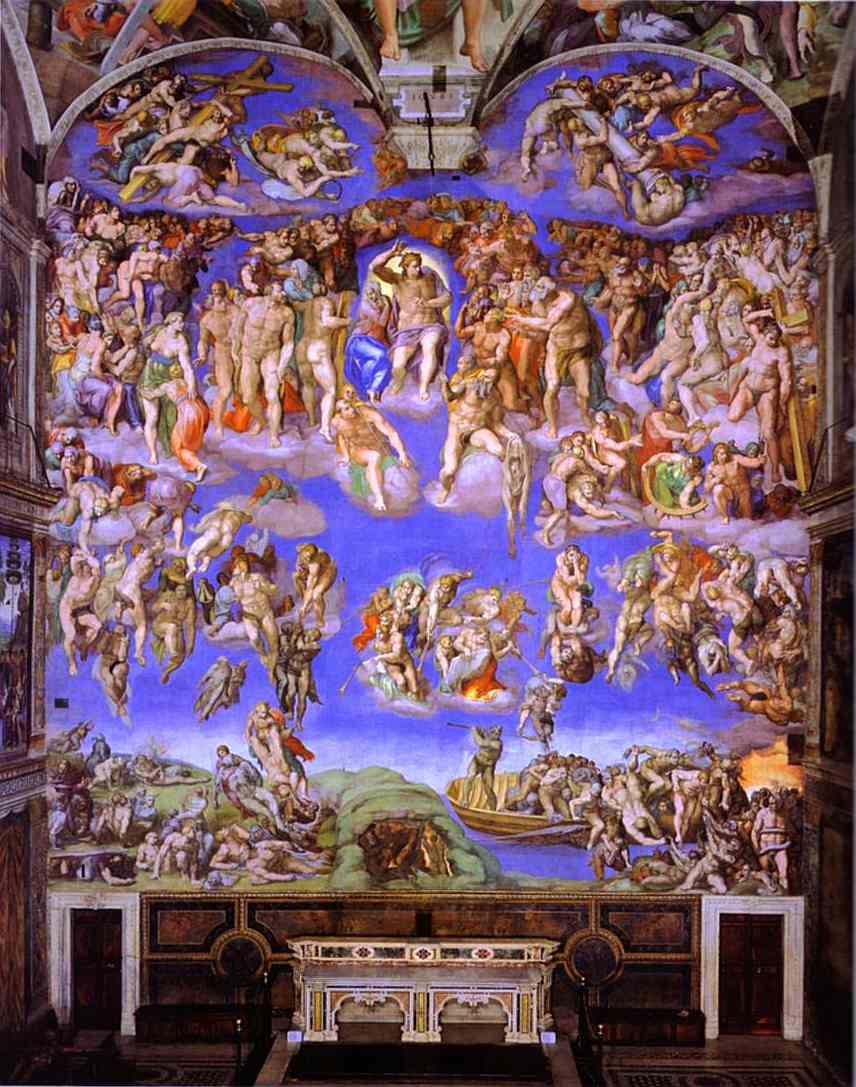
Michelangelo, for one, adopted the pose in his great Last Judgment for the Sistine Chapel for his St. Bartholomew, who was martyred, like Marsyas from Greek myth, by having his skin flayed off. (Marsyas has been suggested as one of the potential models for the Belvedere torso, along with Hercules.)

As a young man, Peter Paul Rubens made an especially fine sketch of this work.

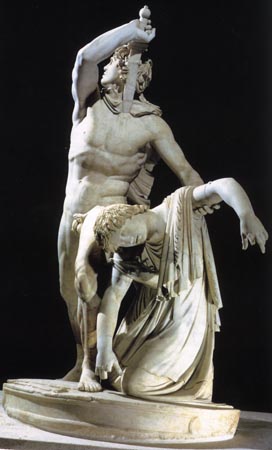
Gaul Killing Himself & The Dying Gaul - the Attalid Monument


Gaul Killing Himself & The Dying Gaul

The so-called "Gaul Group" or "Attalid Monument" was a war memorial, apparently consisting of a central statue showing this Gaul about to kill himself, after having just killed his wife to prevent her capture, surrounded by four dying Gauls. The first important point to understand here about the monument itself is that the Gauls were the enemy; here they are portrayed as heroic, noble, and worthy of our attention and sympathy. In this way the monument resembles the Iliad, where the "enemy," the Trojans, are portrayed as heroic and noble and all of that.

The monument is especially important also for its continuation of the effort, found throughout Hellenistic art, to expand the space under consideration. Lysippos began to redefine the sculptural space in the Apoxyomenos. A piece like the Dancing Faun can only be comprehended by walking around it. Here we have a piece - a collection of pieces, really - that can only be fully comprehended by walking through it. Hellenistic art had pioneered the groupings of elements, as spectacularly in the Laocoon; now we the group extended, into the street, as it were. Hellenistic art is especially vivid in its emotionality; here the dead and dying Gauls touch us with raw emotion.

The Dying Gaul - also called The Dying Gladiator - is especially well modeled. As with the Hanging Marsyas, the body itself expresses the pain and suffering - even the hair seems to hurt. It is the same theme as represented in the late Archaic and early Classic sculptures of the Dying Warriors. Here, though, the realism is significantly enhanced, contributing much to the pathos of the scene.

The Gaul Killing Himself is in the shape of a pyramid, though that ordinarily stable form is rendered unstable by a variety of elements, including the basic narrative being expressed. Regrettably, the woman's arm has been restored badly; apparently it should be parallel with her other arm. The 17th Century French painter Nicolas Poussin used the image for a group in the lower left corner of his Rape of the Sabine Women.


The Laocoon Group

Laocoon

The discovery in Rome of this well-known tour-de-force in 1506 confirmed for the Renaissance artists and scholars who flocked to see it what extraordinary achievements had been made by artists from the Classical world. By then, of course, confirmation was hardly needed, but its obvious power struck a chord. It is a compelling masterpiece that exemplifies the passionate glories of art in the Hellenistic period. Titian adopted the motif for one of his own many masterpieces, showing a follower of Bacchus (Dionysos) enrobed with snakes (which were, in any case, associated with that god).

The story is from the Trojan war and tells of the Trojan priest, Laocoon, who learns of the Greek's planned trick with the horse but is prevented by the gods from telling the Trojans what he has learned. Poseidon sends these snaky monsters to devour him and his sons so that the message never gets delivered.

Whatever you find to say about this work is likely to apply to your outlook on Hellenistic art generally. Although it is an acknowledged masterpiece, many people find it excessively emotional and sensational, so that rather than moving and inspiring the viewer we are made to cluck our tongues and shake our heads. Its frontality annoys people who seem to think that such an elaborately conceived work - such a virtuoso performance - ought to make more demands on our involvement with it. It does seem as much like a relief as a sculpture in the round, and when you think about it, the characters do seem posed. So, the argument seems to be, Why isn't it any better than it is?

Here is Winckelmann, the 19th century critic and theorist, with a more positive approach:

Such a soul is depicted in Laocoon’s face—and not only in his face—under the most violent suffering. The pain is revealed in every muscle and sinew of his body, and one can almost feel it oneself in the painful contraction of the abdomen without looking at the face or other parts of the body at all. However this pain expresses itself without any sign of rage either in his face or in his posture. He does not raise his voice in a terrible scream, which Virgil describes his Laocoon as doing (Aeneid I.222); the way in which his mouth is open does not permit it... The pain of body and the nobility of soul are distributed and weighed out, as it were, over the entire figure with equal intensity. Laocoon suffers...; his anguish pierces our very soul, but at the same time we wish that we were able to endure our suffering as well as this great man does... J. J. Winckelmann, Von der Nachahmung der grieschishen Werke in der Maleri und Bildhauerkunst, 1755, p. 21, (transl. E. A. McCormick) [in Brilliant, 359].
On this criterion, I find the Hanging Marsyas a much more effective piece of rhetoric - and it is far more than rhetoric, of course. However, although I find the arguments against this piece interesting, both because I tend to agree with them and because they help me to see it better, I think its conception is truly remarkable and its power is unqualified.

When I consider this work I am not made to contemplate consciousness as such, only the expression of pain and horror. The point here, for me, is that for centuries Greek artists have been exploring aspects of our conscious lives by representing vivid moments at the margins, near death, at critical points of pain and endurance, with ecstatic and erotic moments that seem to reach into us for implications and associations. This work does not do that for me. This work is one of sheer horror. It leaves by the wayside or crowds out any intellectual or religious dimensions, not (I think) for any reason other than the overwhelming nature of the experience.

What this means, then, is that not only are the geometric harmonies implied by Classical Greek art gone, but also the intellectually sustaining presence of mental exploration. This puts the Laocoon into another category of art - not, for me, a lesser one, but a different one. Hellenistic art similarly will often portray nudes more as erotic devices than for any other purpose, which critics find to be jejune or superficial. And often they are.

But when power like this is evoked from stone, I am content to appreciate and admire.

Here is a passage from a recent discussion of art by Denis Young:

...when the editor of the journal Modern Painters, the late Peter Fuller, referring to the classical sculpture of Laocoön and his sons being strangled by serpents, asked historian Grizelda Pollock, "How do we know that Laocoön is supposed to be in pain?" and she replied, "Because we have studied the mode of production prevailing in Greece at the time, and the signifying practice to which it gave rise." "But," said Fuller, "Laocoön is being strangled by a sea monster!" and her response was, "Yes, but just by looking at the sculpture we have no way of knowing he is not enjoying it." Fuller seemed to think that she had thereby reduced her case to absurdity, but many think that she had not. Psychology has shown that although visual forms may be "expressive," it helps to have cues to tell us what they are expressive of (tears of joy, or of sorrow?). I am reminded of an experience I had years ago when, glancing at a muted television, I saw a crowd of obviously Arabic people waving white scarves and dancing in what appeared to be a jubilant parade -- then I turned up the sound and learnt that they were people from the village where President Sadat of Egypt had been born, who were mourning his assassination in a fashion customary to Egypt.
Maybe I am missing something - am I missing something? - but it seems to me that however critical it is to understand modes of production and signifying practices in particular cultures - since these are things audiences learn without being taught and will understand implicitly, so that if we ignore such things in our approach to art we are likely to make significant errors of judgment and understanding - there are some things, like being devoured by snaky monsters, which we are all likely to perceive without too much mediation, and that the artist or artists of the Laocoon group got this. In fact, even if he did not get anything else right, he got this right.

I am here reminded both of the Kuleshov film editing experiments - in which audiences judged identical shots of faces quite differently when juxtaposed with different things they were presumably encountering (the same face would look hungry before a plate of food and sad before a dead person, etc.) - and Darwin's study of facial expressions, enhanced by the work of Paul Ekman and others - which show various universal expressions of emotions. I am not inclined to pursue this here.

Hanging Marsyas


Hanging Marsyas

The story of Marsyas is one of those common to Greek myth in which a contest between a mortal and an immortal ends poorly for the mortal. He is a faun who discovers the flute cast down by Athene in disgust - it makes her face screw up when she plays it, and she would prefer not to look silly, especially when Aphrodite and Hera laugh at her. Perhaps she places a curse on the flute. These, note, are the same three goddesses from the Judgment of Paris, though the myths do not appear to be related.

Marsyas learns how to play - evidently, being a faun, he has no compunction about making his face look odd - and becomes an adept. Regrettably, either he challenges Apollo or Apollo him - I don't know, and I don't think it matters - and they play, at first, to a draw. Apollo, whose instrument is the lyre, then adds his voice, and plays his instrument upside down, no doubt giving later adepts like Charlie Patton or Jimi Hendrix the idea. When Marsyas is unable either to play his instrument upside down or to add his voice, Apollo wins the contest. His prize is to bind Marsyas to a tree and have his flesh stripped off.

The original was apparently a group, consisting, in addition to our Marsyas, a brutal slave preparing to torture the faun and Apollo, sitting around waiting for the show to begin.

The myth of Marsyas, then, becomes the myth of the artist - the suffering artist - who must undergo the most horrible flaying just for plying his trade in a world where competition leads to winners and losers. Marsyas may lose the contest, but he wins the myth. It becomes a favorite subject for artists, and makes for one of Titian's greatest achievements.

The evocation of pain in this piece is done through the attenuated body, with the ribs all sticking out. The face is remarkably placid; he accepts his fate. This is what makes the piece - and the myth - so potent. We feel the pain through the modeling effects on the body. We approach the stoic suffering, the experience of pain and the consciousness of taking it, of rising above it, through our awareness of the contrast between the painful body and the passive, composed face. Marsyas becomes, here, a tragic figure, contrasting, for example, both with the infamous companion piece, a Scythian slave, shown as a brutal, unthinking torturer - right out of central casting, with flat brow and everything - who sharpens the knife that will tear off the faun's flesh, and with the celebrated Laocoon, whose face reflects as much, or more, anguish as his body.

In class discussion, we generally discover the similarities between this piece and representations of the suffering Christ on the cross - Christus patiens - though I doubt if there is a direct link between the two. In the first centuries of Christian art, the cross was rarely used as a motif; Christ's suffering does not become a significant motif until, I think, after the influence of St. Francis.

Saturday, June 02, 2007

Dancing Faun & Barberini Faun


The Barberini Faun, 200 BCE

Dancing Faun, Pompeii


Emotionality is big in the Hellenistic age, as is excess. We are a long way from what might be regarded as the stoical, almost grim severity of the Classical era. Two very different states of consciousness are presented in these two masterpieces of Hellenistic art. The Barberini Faun is sleeping one off, dead to the world; the Dancing Faun, by contrast, conveys joy, pure and simple.

The faun is a woodland creature, likely as not a follower, like Maenads and satyrs, of Dionysos. They are, hence, associated with wildness, and not just of the wilderness variety.

The Dancing Faun is a justly celebrated piece, found at Pompeii, possibly a copy of a 3rd century BCE Greek original. After Praxiteles and, especially, Lysippos, sculptors began finding ways of presenting their work from any and every angle, and of extending the space created by the work outwards towards the viewer. Sculpted characters like this faun could by their gestures establish a more dynamic relationship with the space around them, and so, too, with whoever inhabits that space. We are a long way from the strict frontality of Archaic and early Classical work, where the pieces practically position the viewers in front of them and say, Hold still! For this piece, we can not fully comprehend it without moving around.

The Maenad of Skopas seems completely ecstatic, in the literal sense of being out of her body. This faun seems not so much out of his body as completely and fully within it. It might be a dance step, but seems more probably a spontaneous, finger-snapping leap of pure, infectious pleasure.

Perhaps the Barberini Faun was dancing like that last night, but now he has unguardedly fallen into a sodden state. Richard Brilliant says that the piece "seems to present that moment of physical and psychic transformation when the bonds of wakefulness are finally loosened at the entrance of sleep” (Arts of the Ancient Greeks, 345).

Clearly a work of homoerotic art, it is possible that the emperor Hadrian - a connoisseur of both art and boys - placed the Barberini Faun in his Mausoleum in remembrance of his beautiful young lover Antinous, who had drowned. It is, in any case, both sensual and amusing at the same time.

The Venus Kallypygos and the Three Graces


The Venus Kallipygos
The Three Graces

Hellenistic art was for long considered..., well, if not degenerate and trite, perhaps prurient and superficial. The significant difference between this style and styles from the Classical period seems to be that now a far less rigorously geometric aesthetic applies. Out with any canon of proportions and abstract harmonies - which somehow put us in tune with the underlying pattern of the universe - and in with shapely bottoms.

It does seem a bit odd that we are asked to consider a beautiful woman admiring her butt. In fact, I am persuaded by the interpretation that both of these pieces represent dance steps. However, there is no denying that the Venus Kallipygos does have a beautiful ass, and that, in fact, is what kallipygos, or callipygos, means in Greek. The story was told of a couple of sisters arguing over whose was best, and a couple of brothers, each of whom selects the other, and they end up getting married, blah blah blah. Stupid story.

The dance step interpretation makes sense to me, in part because of the overwhelming importance of dance to Greek culture, and because there had always been, I gather, a sense of the beautiful relationship between dancing and sculpture. That is, sculptors who sought to represent the body in motion had in mind the particular steps a dancer would take because assuming such a pose would imply to the audience, all of whom were familiar with the dance, the next step. If one such pose had a beautiful woman turning to the back, and the sculpture then apparently represented her admiring herself from the rear, the pose would have caught on as a sculptural motif for those Hellenistic prurient reasons mentioned above. It is not a great work, but it is certainly a popular one.

Even more popular, and by far better achieved, is the design of the Three Graces. Again, this may have originated as a dance step, but with three women - each deriving from the Praxitelean Knidia - in line it became associated with those goddesses known as the charites, representing Aglaia (beauty, radiance), Euphrosyne (joy, mirth), and thalia (fruitfulness), all associated with Aphrodite.

The three Graces had formerly, apparently, been portrayed as clothed; somebody at some point in the Hellenistic period had the bright idea of disrobing them. They are a common motif in Western art and can be found in first century (CE) Pompeii, and in Renaissance paintings of Sandro Botticelli (Primavera) and Raphael (The Three Graces); Rubens' version is from the 17th Century.

Lord Clark calls the Three Graces "one of the last beautiful inventions of antique art." The harmonious rhythms created by the lines are very much like those created by dance.

The Winged Victory of Samothrace

The Nike, or Winged Victory of Samothrace, Pythokritos of Rhodes, 250 - 180 BCE

We lived in Paris when I was 15 and visited the Louvre several times. Like any kid, I was struck by innumerable scenes and images, but clearly the most powerful, dramatic, and effective image for me was the Winged Victory from Samothrace, which stood at the top of a flight of stairs and looked for all the world as if she was flying, or perched on the prow of a ship, represented as the base. A stiff wind seems to ripple through her garments and she seems to push against it, thoroughly embraced by its pervasive touch. She must be enjoying this, I thought, as we would enjoy the swirl of breezes on a boat or during a storm. We are meant to share her exhilarating sensation of sensorial transport.

Of course, she has wings - marvelous, magnificent wings – that look truly as if they could carry her body, as they apparently just have, through the wind, guiding her as she alights on earth, or perhaps on a building, or even a boat. The wings extend out back as her breasts push forward, providing both balance and momentum to the upper torso.

The sculptor uses shadows effectively, enhancing the swirling folds of the garment and the play of light as it ripples across the surface.

She was used as the model for the Spirit of Ecstasy, the Rolls Royce hood ornament.

Friday, June 01, 2007

The Aphrodite of Kyrene


Aphrodite of Kyrene

The carving of this Roman copy based on the Knidia is especially fine. It is also a good piece by which to appreciate again the lines of the female contrapposto.

The missing head and arms do nothing, for my part, to reduce the human agency present in this piece. As with the Aphrodite of Vienne, the fragmentary nature serves to focus our attention on the delicate naturalism and refined sensuality of marble brought as close to life as conceivable.

The Crouching Aphrodite


The Crouching Aphrodite, or the Venus of Vienne, Diodalsas of Bithinia, 3rd C BCE

Here is another relative of the Knidia in a pose that became extremely popular in Hellenistic, Roman, and Renaissance art, and beyond. She is presumably bathing, perhaps under a shower of water. For me, it is one of the glories of art in any age - if we could just remove that pesky strut underneath the right leg, which would not have been present in the bronze original.

The folds at her waist are modeled with wonderful precision and contrast well with her thighs, so full of energy and elegant angles. She is poised, balancing herself as she washes, turning, perhaps for more water, perhaps in recognition of the presence of some attendant, or even the gaze of some onlooker - us - me. I don't miss the head or face, I think because the concentration is so evident in the engaging expression of every line and fold of her sensual body.

Richard Brilliant describes:

...a life-size substantial nude, self-enclosed within its pyramidal shape, yet strongly composed from many points of view; the artist has contained the contrasting movements of limbs and head within a stable but energetic figure realized with harmonious grace as a living female, fully developed and luxuriantly clad in a rich mantle of soft flesh (Arts of the Ancient Greeks, McGraw-Hill Book Co., 1973, 363).

He draws a contrast between this fine piece and the "decorative aesthetic" of a statuette from about a century later from Rhodes:

carved... in translucent marble, simplified in form and virginally slender, now seen delicately extended along a single plane in a tableau of sweet loveliness The different between these versions also lies, significantly, in the distinct reactions elicited: Wow! And How nice (Brilliant, 365).

Thursday, May 31, 2007

The Capitoline Aphrodite and the Venus de Medici


The Capitoline Aphrodite (left)
The Venus de Medici (right)

Both of these female nudes illustrate the Classic pose known as the Venus Pudica, or Modest Venus, as it appears she is trying to cover her breasts and genitals with her hands. Both derive from the idea first exploited by Praxitiles in the Aphrodite of Knidos, but in a more compact and distinctive manner. Lord Clark contrasts the Capitoline with the the Praxitilean model:
The Knidian is thinking only of the ritual bath she is about to enter. The Capitoline is posing. Herself self-conscious, she is the product of self-conscious art. Her pose, whenever it was evolved, is the most complete solution in antique art of certain formal problems presented by the naked female body; and it is worth trying to see how this has been achieved. … At no point is there a plane or an outline where the eye may wander undirected. The arms surround the body like a sheath, and by their movement help to emphasize its basic rhythm. The head, left arm, and weight-bearing leg form a line as firm as the shaft of a temple. Approach the Knidian from the direction to which her gaze is directed, and her body is open and defenseless; approach the Capitoline, and it is formidably enclosed.

Clark is not fond of the Venus de Medici, referring to its "vapid elegance" as "stilted and artificial."

With these two characters branching off from the Praxitilean model, a schema for the female nude in western art has been established which will become standard visual practice for centuries. She will usually depict the goddess Aphrodite, generally with her Roman identity, Venus, and at some point around this time, it seems, she will no longer be the object of religious veneration or cult, or at least, not exclusively. Elements of the female nude from now on and until the modern era, however else they are configured, will often involve some relationship to the Knidia.

The elements of the female nude consist principally in her poses and her anatomy - as it is with the male nude - and how the different parts and gestures of the piece interact. We learn to look at the body - head, face, arms, legs, hands, feet, hair, genitalia, and whatever drapery there is, along with other parts of the scene such as the hydria or a shield - finding ways in which one part will parallel or contrast with another - as part to part and part to whole - creating or exploiting geometrical abstractions (as earlier in the Greek tradition) or not (starting in the Hellenistic age) and with more or less realistic and naturalistic modes of expression, and more or less abstract modes. The Classical ideal has been widely influential.

Also, of course, we find relations between the piece and ourselves, the audience, spectator, me, you.

Elements of the female nude are bound to include something about the social and erotic character of the person represented; when the cult is abandoned, women will be represented more as they are seen by sculptors and their audiences than by how the goddess is or was - worshiped. Miranda Marvin's review of the book, The Aphrodite of Knidos and her Successors: A Historical Review of the Female Nude in Greek Art. (Ann Arbor: University of Michigan Press, 1995. Pp. 158. ISBN 0-472-10585-X) is worth reading for a survey of the Praxitilean model of the female nude.

Approaches to the female nude since the 19th century - when the Praxitilean ideal was both revived and challenged, have tended to problematize the subject.

Head of Alexander


Head of Alexander, Lysippean tradition c, 200

This is a portrait of Alexander the Great. One of his generals is said to have done a double take when he passed the statue, after Alexander's death. The dreamy look, with the eyes cast upward and the mouth slightly open, was widely copied.

Alexander, of course, was the most significant, world-changing leader of the Classical world. From Macedonia, just north of Greece, he went on to conquer most of the known world. One of his teachers was Aristotle, the great Greek philosopher and natural scientist, and Alexander was a strong proponent of Hellenic (Greek) culture. Upon his death his generals divided up the empire, most of which continued with the sort of Greek traditions and culture Alexander had brought to them. This is when the Hellenic becomes the Hellenistic.

This is probably one of the first portraits we possess. The head of Themistokles, from several centuries before, seems very much like a portrait, so this would not be the first. From this piece we get a sense of Alexander's character or temperament.

Tuesday, May 29, 2007

The Venus of Arles and the Venus of Capua


The Venus of Arles, Roman copy of Praxiteles original
The Venus of Capua, Roman copy of 4th C original

The Venus of Arles is probably a copy of an original statue by Praxiteles. The Venus of Capua is a variation on the pose. The pose here is what interests us; it. Like the Knidan pose, it was widely copied in later art, with its most successful interpretation the Venus de Milo.

Aphrodite here is somewhat more regal than in other representations, and is associated with military conquest. Aphrodite holds in her hands the shield (now missing) of her lover, Ares (Roman Mars), the god of war. She is admiring herself in its reflection. A common motif in the art of the West will be the Venus at toilette, in which she looks into a mirror. In this representation, she seems absorbed in thought.

Neither of these statues, it should be noted, can represent much of what the original would have been. The Arles, which was discovered in the 17th century, was re-worked at King Louis Xiv's instructions. Although the revisions were done by Giraudon, a fine sculptor, the tastes of the time - the King's tastes in particular - were to avoid messy things like muscles and ribs, and so the torso was smoothed out. Bad idea.

The drapery is very low, and looks about to slip off, which somewhat diminishes, or transforms, her regal presence; perhaps she is thinking too much and, hence, unaware of her imminent wardrobe malfunction. In a sense, then, these pieces re-frame the idea of energy and motion discovered, for example, in Myron's Discobolos - who is about to throw the discus - and in the Polykleitos's Doryphoros - who is about to take a step.

The drapery around the legs has the effect of providing a solid - albeit slippery - base for the figure. As Lord Clark points out,

It has always been the despair of sculptors that the torso, that perfect, plastic unity, should rest on tapering, spindly supports. Praxiteles has simply draped the legs and left the torso bare. He has thus achieved so firm a foundation for his figure that he can dispense with any support—vase, pillar, or dolphin—and allow the arms free play (The Nude, 130)