Saturday, April 14, 2007

On the Kouroi


Kenneth's Clark's The Nude is a classic study of this classical theme. Here is an extended passage in which he explains the role of Apollo and the significance of the Kritios Boy.


The Greeks had no doubt that the god Apollo was like a perfectly beautiful man. He was beautiful because his body conformed to certain laws of proportion and so partook of the divine beauty of mathematics. The first great philosopher of mathematical harmony had called himself Pythagoras, son of the Pythian Apollo. So in the embodiment of Apollo everything must be calm and clear; clear as daylight, for Apollo is the god of light. Since justice can exist only when facts are measured in the light of reason, Apollo is the god of justice; sol justitiae. But the sun is also fierce; neither graceful athlete nor geometrician’s dummy, nor an artful combination of the two, will embody Apollo, the python slayer, the vanquisher of darkness. The god of reason and light superintended the flaying of Marsyas.

But the earliest nudes in Greek art, traditionally known as Apollos, are not beautiful. They are alert and confident, members of a conquering race, “the young, lighthearted masters of the waves.” But they are stiff, with a kind of ritual stiffness; the transitions between their members are abrupt and awkward, and they have a curious flatness, as if the sculptor could think only of one plane at a time. They are notably less natural and less easy than the Egyptian figures upon which, to a large extent, they are modeled and which, over a thousand years earlier, had achieved a limited perfection. Stage by stage, in less than a century they grew into models that were to satisfy your western notion of beauty till the present day. They have two characteristics, and only two, that foreshadow this momentous evolution. They are clear and they are ideal. The shapes they present are neither pleasant in themselves nor comfortably related to one another, but each one is firmly delineated and aspires to a shape that the measuring eye can grasp. Historians who have written in the belief that all art consists in a striving for realism have sometimes expressed surprise that the Greeks, with their vivid curiosity, should have approached nature so reluctantly; that in the fifty years between the Moscophoros and the funeral stele of Aristion, there should have been so little ‘progress.’ This is to misconceive the basis of Greek art. It is fundamentally idea. It starts from the concept of a perfect shape and only gradually feels able to modify that shape in the interests of imitation. And the character of the shapes chosen is expressed in the word used to describe the earliest form of Greek art, geometric; a dreary, monotonous style and at first ill adapted to realization in the round. But the head yields easily to geometric treatment, and already in the most archaic heads of Apollo we see how geometry can be combined with plastic vitality. In a century the same unifying power will subordinate the dispersed and intractable forms of the body.

So Apollo is clear and ideal before he is beautiful. How and when did the transformation take place? Ranging in a hypothetical order of time the kourai—the nude male figures—of the sixth century, we see the transitions from shape to shape becoming smoother, and absorbing, in the process, details that had been left as decorative notations. Then, quite suddenly, in about the year 480, there appears before us the perfect human body, the marble figure from the Akropolis known as the Ephebe of Kritios. Of course we was not really a sudden, isolated creation. We have only a slender reason to attribute him to the sculptor Kritios, and we have even less reason to suppose that Kritios was the initiator of so momentous a change. Literary sources give the name of Pythagoras of Rhegium as the sculptor who ‘first gave rhythm and proportion to his statues.’ All the evidence suggests that the new concept of form would have been first expressed in bronze and not in marble; and the Apollo of Piombino, although slightly earlier and stiffer, may give some notion of what had been going on in the first twenty years of the fifth century. But since almost every bronze statue made in Greece in classic times has been melted down, the Ephebe of Kritos remains the first beautiful nude in art. Here for the first time we feel the passionate pleasure in the human body familiar to all readers of Greek literature, for the delicate eagerness with which the sculptor’s eye has followed every muscle or watched the skin stretch and relax as it passes over a bone could not have been achieved without a heightened sensuality... [T]wo powerful emotions ... dominated the Greek games and are largely absent from our own: religious dedication and love. These gave to the cult of physical perfection a solemnity and a rapture that have not been experienced since. Greek athletes competed in somewhat the same poetical and chivalrous spirit as knights, before the eyes of their loves, jousted in the lists; but all that pride and devotion which medieval contestants expressed through the flashing symbolism of heraldry was, in the games of antiquity, concentrated in one object, the naked body. No wonder that it has never again been looked at with such a keen sense of its qualities, its proportion, symmetry, elasticity, and aplomb; and when we consider that this passionate scrutiny of the individual was united to the intellectual need for geometric form, we can estimate what a rare coincidence brought the male nude to perfection.

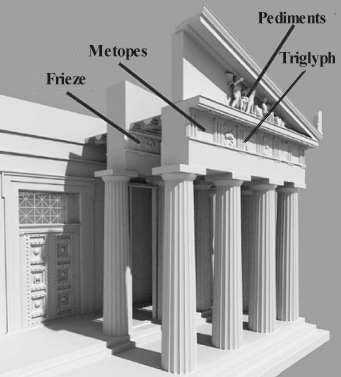
Perfection hangs by a thread and is weighted in the jeweler’s balance. We must therefore submit the classic nude, at its first appearance, to an examination that may seem fastidious, until we remember how the rhythmic organization of this form was still dominating sculpture 2300 years after its invention. When, a page ago, I used the Apollo of Piombino as an example of bronze casting, how strikingly it brought out the classic character of the Kritios youth! In twenty years a basic alteration of style has taken place. It can be illustrated by examining the lower part of the torso—to be precise, the junction of the hips, abdomen, and thorax. One of the most peculiar features of the early kouroi—for example, the Apollo of Tenea—is their thin, flat, stomachs. They conform to a sharp, ogival rhythm, which we may describe as Gothic. The chief areas—thighs and stomach—are inscribed within elongated ovals. Gothic nudes, dominated by the pointed-arch form, do in fact display very much the same characteristics, and one of the earliest nude studies that have come down to us, a drawing in the Ufizzi from the circle of Uccello, combines Gothic and naturalistic forms with a remarkable likeness to a sixth century kouros. In the Apollo of Piombino these Gothic forms are less marked. The thorax is of classic rectangularity, but it bears an uneasy relationship to the flat triangle of the stomach. Like Perrault’s facade of the Louvre, we feel that a richly classical upper story is resting on a base too stiff and thin to support it. In the Kritios youth this uneasiness has vanished altogether. The legs and divisions of the torso flow together with the same full and fruitful rhythm. How is this achieved? To begin with, the hips are not parallel, but since he rests his weight on his left leg, that hip is slightly higher. The full implications of this pose are more easily seen from behind, for, as usual in early Greek sculpture, the back is more naturalistic and more plastically developed than the front. But even from the front we can perceive, for the first time, that subtle equilibrium of outline and axis which is to be the basis of classical art. This delicate balance of movement gives the torso its unity of rhythm. It also allows the sculptor to solve the problem of the abdomen by realizing it as a dominant, as opposed to a recessive form: and this has involved an anatomical emphasis that was to be exaggerated to the point of distortion in the next fifty years. I refer to the muscles that lie above the pelvis and mark the junction of the thighs and the torso. They are largely absent from archaic sculpture, and since it seems unlikely that between the years 500 and 450 Greek athletes really did develop these muscles to such an unequaled extent, we must reckon them chiefly a device by which the rhythmic structure of the torso might be set in motion, and its lower half supported by two buttresses, before descending to the arc of the abdomen. They were elements in the classic architecture of the human body, and as such they lasted as long as metopes and triglyphs.

All this we discover in the youth of Kritios when we compare him to the figures that precede him. But it is not obtruded. He is so straight-forwardly beautiful that we do not willingly use him to demonstrate the mechanics of form or the rules of an aesthetic theory. To the sculptors of the next generation this grace and naturalness was a defect, or at least a danger. It is as if they foresaw the frivolous beauty of Hellenistic art, and wished to defend themselves against it as long as possible” (Kenneth Clark, The Nude: A Study in Ideal Form, Doubleday Anchor Books, Garden City, New York, 1959, pp 55, 57, 61-3).

The Kritios Boy


The Kritian Youth, c. 480 BCE

He is one of the most important pieces of art from the period. He inaugurates what has become known as the Early Classical Age of Greek art. However much he may resemble his ancestor kouroi figures of before, he resembles far more his later cousins. He is no longer Archaic, but Classical. All of his ancestors looked right past us into some never-never land.

By contrast, the ‘Kritios boy’ in the Acropolis Museum in Athens seems as if he might turn and ask you a question… The sculptor… broke with the 150-year-old kouros stance by shifting the seeming stress of the weight to the left leg while leaving the right leg, with the knee slightly bent, free to balance or propel. The displacement of the weight to the left leg raises the left hip and causes a slight unevenness of the axes of the torso. The head turns to the right, to complete the break with the rigidly frontal kouroi. The effect of these technical devices is to create a figure which seems to hesitate to be uncertain about what it is doing and where it will go. It seems conscious of its surroundings and faced with alternatives which ask for judgment and decision. In short, it seems to live and think” (Pollitt, 17-18).
In addition to the revolutionary new pose, known as contrapposto and found all over the art of the western world from this point on, the boy's face has lost the Archaic smile. He pouts, or looks "severe."

For this is indeed not merely a beardless male figure but a boy, whose soft flesh, trim but undeveloped musculature, and genitals are those of an adolescent. The greater specificity which the increasing richness of reference to the male form inevitably brought with it makes the fiction that this is a universal symbol impossible to sustain; rather than mirror the gaze of the viewer and enter the viewer’s story, this boy turns his head intent upon his own story in which the twist of his hips guarantees that he is an actor and not merely a spectator. No longer engaged, the viewer now searches for clues about that story, eyeing the boy up and down and appreciating the attractions of his youthful body. The world and delights of the symposion have here entered the religious sanctuary” (Osborne, 159).

Fallen Warriors, Pediment, Aphaia Temple


Fallen Warrior, West pediment, Aphaia Temple, c. 490 (left)

Fallen Warrior, East Pediment, Aphaia Temple, c. 480 (right)

These two warriors have both fallen in battle. Both are dying. Yet their response to this calamity is presented by the artist--surely two different artists-in opposite ways, demonstrating, perhaps as well as can be done, the distinction between the grand Archaic style and the new Classical style.

The warrior from the west pediment [490] has been struck in the chest with a spear (of bronze or wood, now missing) which he grasps with his right hand while he props himself up on his left elbow. His expressionless face, sprucely set off by the beaded bonnet of his hair, stares out at the viewer. His right leg is arched over the left, giving a clear, almost delicate silhouette, evocative of the crisp figures of early Attic red-figure vase paintings. Rather than suffering from an excruciatingly painful wound, he seems to be posing for a dignified court tableau.

The fallen warrior from the east pediment [480] is another matter. As life ebbs away and he sinks toward the earth, he tries futilely, sword (now missing) in hand, to raise himself. His eyes narrow as his consciousness fades; his mouth is slightly open as his breathing grows difficult; he stares at the earth. His enfeebled movements contrast poignantly with his massive physical frame in which, for practically the first time, the individual details of musculature are fused and unified by a softening of the lines of divisions between them, and by increasingly subtle modulation of the surface from which one senses the presence of a unified physical force emanating from within the body. The sculptor who conceived the figure had obviously thought carefully about exactly what it meant. He must have asked himself what it must really be like when a powerful warrior is wounded and falls. What does he feel? How should we feel? And what meaning is there in our feeling? The warrior from the west pediment seems more like a recumbent kouros; his companion from the east pediment is a character in a drama (Pollitt 19-20).

The earlier, East pediment figure is, indeed, posing. "Look," he seems to say, "I have an arrow in my chest, which I will now remove." The sculpture is highly patterned and arranged, so that each of the limbs echoes the others, and each creates a singular triangle pattern repeated throughout the design. This is art expressed, as so much Greek art from the Geometric through the Archaic periods had been expressed, through repetition, design, parallel rhythms, and geometric shapes played out across the whole.

The later, West pediment figure, is dying, at the last moments of breath and consciousness. He has just tried to struggle valiantly up, it seems, but has collapsed. There is some awkwardness about the midriff-the artist is unused to depicting a body twisting around-but the scene is gripping and emotional.

Both of these pieces may be compared and contrasted with, for example, earlier depictions of the dead from the prothesis scenes of the Dipylon Vase, and with later manifestations of the theme found in the Dying Gaul.


The Strangford Apollo


The development of the kouros figure is marked by the tendency to increase both the physical naturalism of the male figures-they look increasingly real-and a growing humanity. The Strangford Apollo (500-490) is more of a human than a god-it is not easy to tell with some of the earlier kouroi. The modeling of the anatomy is getting closer to the real thing, but the face remains impassive, except for that Archaic smile, and the hair remains finely patterned. He has in common with all his kouroi ancestors the frontal, hieratic pose that removes him from inhabiting the same space we do as we look at him. He never looks back.

The Anavyssos Kouros


The Anavyssos Kouros, c. 520

Stand and have pity at the tomb of the dead Kroisos, whom raging Ares slew as he fought in the front line
.

The kouroi figures (kouroi is plural for kouros) develop through the decades of the Archaic period from the delineation characteristic of the New York kouros to the modeling found on the Anyvassos kouros, which is dated to about 520. He marks the grave of one named Kroisos, who died in battle; the inscription is above. He is not, certainly, a portrait, but, rather, an idealized picture of a young man. Similar kouroi were placed at the graves of old men, again, not to portray the individual in life, but to suggest the ideal model of a man at the peak of his beauty and power. The modeling is beginning to show actual muscles, and the articulation of the limbs is far more naturalistic. For some (i.e. Woodford) the enhanced realism of the body clashes with the highly patterned and traditional treatment of the hair. It doesn't bother me, but, then, what do I know?

The man who looks on a kouros finds himself being looked upon by a figure that is male and impassive: here is a male who stands firm, unbending, and constant. Such a figure makes a dutiful servant to the gods or to the city, but also an image of the unageing constancy of the gods themselves.
...
Where the New York kouros is made up of flat planes, the Anavyssos kouros, though as tightly constructed, bears few traces of its origins in a block of stone—a contrast particularly marked in the treatment of the buttocks. Where the New York kouros simplifies the face so that only eyes, nose, and mouth impinge on the rounded surface, the Anavyssos kouros gives separate form to cheeks and chin. None of these features make the Anavyssos kouros into an individual, rather than a type, but they enrich the reference to the male body and in doing so enrich the sense of potential, the sense that this sculpted man belongs to the same world as the viewer. They show something of the scope that the naked male form offered to sculptors, who, in hundreds of kouroi produced during the sixth century, explored different ways of bringing out what it was to be a man” (Osborne, 81-2).

2 Archaic Korai

Acropolis 594, on the left.

The Chian Kore, on the right.

Korai is plural for kore, meaning maiden or daughter, the always clothed feminine figures of the Archaic period. These korai from the Athenian Acropolis, date to the latter part of the sixth century BCE. They wear a sleeved chiton and himation, or cloak, draped diagonally over the body, and would originally have held an offering in their extended hand. Both pieces revel in the fall of drapery around the bodies of the young girls, revealing both the breasts and the legs beneath. Our eyes engage with the folds as they make their sinuous tour of the bodies, which are made to appear lively and energized. Certainly, these girls are fancier and freer than the Peplos Kore, and their finery is more elegant. The Chian girl's hair is in an elaborate do. They were both painted brilliantly; paint remains on the Chian maid's dress show it was dark blue with a reddish band at the neck. Her cloak was originally spangled with red and blue spirals and triangles.

It is conceivable that we are getting increasingly towards more individualistic (rather than idealistic) representation.

Moschophoros


The Moschophoros ("the calf-bearer," 570-60 BCE) is a delightful work showing a young man bringing a calf to sacrifice, probably for Athena. The motif is fairly common in Greek art, and was adopted by Christians later. His archaic smile is somewhat less delightful than that of the Peplos kore, though both the eye sockets (originally filled) and broken chin may set that off somewhat. His face and staring reveals a dedication to purpose somewhat belied by the almost whimsical style.

The legs of the animal and the arms of the man form a clearly delineated X pattern, which delightfully integrates naturalistic with geometric forms and unites animal and human in harmonious design.

The Peplos Kore


The Peplos Kore, from the Athenian Acropolis, c. 530 BCE

Here she is, truly one of the most delightful creations of all, wearing a peplos (hence her name) and still sporting some of her original paint. Her garment is heavy (wool), modeled to reveal both its own texture and something of the feminine form beneath. It is gathered at the waist where it is cinched by a belt, and pinned at the shoulders by fibulae. Her hair is braided elegantly and falls in three braids on either side of her breasts and arms.

Clearly, the artist is interested in that garment; as simple as it is, as plainly as it falls around the girl, it seems to reveal not only her body but. perhaps, something of her character. We are not wrong, it seems to tell us, to take her for what we see - a simple, charming, delicate young girl. It also reveals the artist's interest in the problems of modeling. This will become of very great interest to artists from now on, who will explore the contours of the body by way of the fall of garments around it in endlessly fascinating ways.

The peplos permits the artist to make a vertical base for the upper body. The gentle modeling only just reveals aspects of the anatomy beneath. The upper half is far more alive and revealing. The archaic smile seems not only pleasant, as usual, but personal, even quirky.

It is likely that the original statue was intended as some sort of votive offering, perhaps to Athena. Her left hand, now broken off, was extended - the shoulder above is lifted slightly - and may have held something for the goddess. However much the artist labored for Athena, however, he labored as much or more for the girl.

Achilles and Penthesileia, Exekias


This Exekias black-figure design dates to around 530 BCE.

The story depicted here, quite a common one in Greek art, shows Achilles killing the Amazon Queen, Penthesileia. As the fatal blow is delivered, however, their eyes lock and, as maybe you've guessed already, they instantly fall in love. And she dies. It is one of the many scenes in Achilles' life that Homer wisely decides to omit.

Note how black and murderous Achilles seems, quite rightly, to be. His helmet is down, shielding his face. Her face, however, is exposed. Amazons were, for the Greeks, awkward monsters. They represented the uncivilized, perverse, un-Greek extreme. Note the Amazon's white skin tone here, traditionally used for women to indicate they spent time indoors; it seems odd here, though does emphasize her delicate nature and underscores the brutality of the act. As violent as the scene is, however, it is also a posed scene. Achilles lumbers up somewhat stiffly, and Penthesileia strikes a theatrical pose. It is as if they are rehearsing the scene.

I don't know what to make of the swirling lines around them.

Ajax and Achilles at Dice, Exekias


Ajax and Achilles at Dice, Exekias, 540-530 BCE

Here is our Ajax again, on the right, but in a scene far more pleasant and enjoyable than either running off the battlefield carrying the corpse of Achilles or planting his sword in the ground to end his own life. He is playing a game with Achilles-we may call it dice, but it might be chess, or checkers, or what have you-both men ready for battle-they are in a tent at Troy-but intently engaged on the problem before them on the gaming board. The artist has linked the game that absorbs these warriors with the war raging outside. The elaborate refinery both of the garments these soldiers wear and of the execution itself, by that great black-figure painter Exekias, is especially notable. For me, the intensity of their concentration on their game mimics, or calls to mind, the intensity of the artist at work in creating such exquisite patterns.

I like the interpretation of the scene as one that shows Achilles with his friend during the time after he has pulled away from the Greeks, because of Agamemnon's insult. I am not sure, however, why, in that case, Achilles would be wearing his helmet. This interpretation, though, does a lot to help us find suggestive forebodings in the image.

The scene is widely reproduced, yet difficult to capture. It really needs to be understood, as so many of these vase paintings do, in the context of the entire amphora. Their two shields, for example, have been placed behind them at such an angle as to extend up into the handles of the vase. This acknowledgment of the shape, form, and physical presence of the vase qua vase in the image itself is one of the glories of this sort of art. Similarly, their spears also point to the tops of the handles above. Furthermore, each of their backs curves in a way that echoes the curve of the vase. These characters are both at Troy and on a vase painting. And they seem to know it. Take a look at a close up of Ajax's face, where intensity of human thought combines with patterned elegance of design.

It is one of the great features of Greek art to explore consciousness. This work exemplifies that concern.

Ajax Contemplating Suicide, Exekias


Ajax Contemplates Suicide, Exekias, around 540 BCE.

This is a deeply tragic scene, rendered with an exquisite sense of pain and loss, conveyed by every element of the figure. Ajax, whom last we met valiantly carrying the dead body of his great friend, Achilles, is preparing to take his own life. Here he is, having been rebuked, he feels, by his fellow Greeks, who have awarded the magnificent armor made for Achilles by Hephaestus to Odysseus instead of to him, thus rewarding brains over brawn; he is finding a way to fix his sword to the ground so that he can fall on it. His shield lies over to the side, abandoned. Even the palm tree looks dejected. Although the image works well seen close up, I think it is important to see how it fits within the entire frame of the amphora.

...[A]rtists began to explore the implications of conclusive action before it occurs. With sensitive foreboding worthy of a Solon, Exekias, the greatest black-figure vase painter, suggested the results of action not yet taken as well as the preparatory state of mind of the actor. On a famous vase of about 540 B.C., now in Boulogne, Exekias showed Ajax planning suicide, his energies entirely focused on fixing the sword into the ground prior to impaling himself; the heavy body perched precariously on tiny feet hints not only at the instability of Ajax’s mind but also at his imminent fall on the fatal blade (Richard Brilliant, Arts of the Ancient Greeks, McGraw-Hill, New York, 1973, p 73)


Friday, April 13, 2007

Dionysus Cylix, Exekias


This Cylix by Exekias, which is dated around 540-30 BCE, is one of my favorites. And why not? My own personal preferences for subject matter in works of art are for boats or (and) nudes. The boat here is exquisite, as is everything else.

The story illustrated here is from the Homeric Hymn to Dionysus. It seems the new god, a mere lad, is kidnapped by some dim pirates who fail to recognize the god's potent powers. The new god Dionysus takes command of the ship, has the spars bear grape vines (for wine), and when the frightened sailors jump ship, they turn into dolphins, flippers and all.

And there they are, all around the curve of the bowl, echoing both the lines of the boat and the round shape of the cylix itself. And there are seven of them, just as there are seven new clusters of grapes growing from the vine emerging from the mast. And there is Dionysus himself, setting a fine example by drinking as he enjoys his little sail, lying, relaxed, on deck.

However we look at the scene, there is no distinction between sea and sky, no horizon. It is a justly famous work.

This work, according to Gardner's Art Through the Ages,

...heralds the beginning of a revolution in the world of art... In his drawing of the boat’s sail, Exekias does not show a traditional and conventional symbol that ‘reads’ as a sail, but a sail as a sail would actually look, bellying out and filled with wind. It is an image of the action of the wind itself, the wind made palpable as a force, and it must have come from a new awareness of the physical presence of nature. This awareness is abroad; it is in the Ionian speculation about the physical constitution of the world, and in the reality-charged poetry of Homer…(112)
The estimable Raymond Schoder shows us more:
The whole is nearly integrated with conscious care for balance and subtle interrelationships. The grape clusters above match the dolphins swimming below, and the two on the sides harmoniously complete the inner circle of objects parallel to the outer rim. Curvature of sail and boat counterbalance one another around the center and the varied lines of the dolphins in relation to the rest add to the rhythmic symmetry. The ship’s mast forms an axis around which all is unified. A mysterious, timeless effect is achieved by the monotone background—unreal in color and in omission of distinction between sea and sky. Our eyes are intrigued by this cunning play of lines, our minds challenged by the problems set for interpretation and analysis. Few works in the whole range of Greek art have so much to elicit our awe, admiration, and delight.
...[W]e can enjoy the smaller refinements of drawing in the god’s fine robe, the ship’s rigging and graceful shape, the snout on the prow and curving high stern, the white dolphins along the side, and the gay, lively ones swimming freely to and fro. Altogether, this is one of the most delightful art works surviving from the ancient world (Schoder, #14).
And, remember, it was an object to be used. It held wine. It was held in the hand, raised to the lips. People drank from it. How cool would that be?
The ship is set at an angle to the handles of the cup it decorates. As the drinker drained his cup, he would notice the painting and, turning the vessel in his hand to see it more clearly, would make the wine swirl around so that the image would seem to be emerging from beneath the wine-dark sea itself. The subtly calculated balance of forms and the lyrical mood of this cup interior are unmatched in the whole of Greek art (Woodford, 1984, 25-6).

Ajax Carrying Achilles - The Francois Vase


Ajax Carrying the Corpse of Achilles, Kleitias, The Francois Vase, 570-560 BCE

The overwhelming impression I get from Archaic Art is the influence of Homer. I can't prove it, but I feel the artists here, like Kleitias, responding to the vividness, the life, the sensory details, and above all to the narrative drive of the great epics. Here, in a scene anticipated by the entire Iliad, but which will occur after the epic ends, Ajax, second only in valor and strength to Achilles, carries the body of his dead comrade off the battlefield.

The dead body is heavy and stiff. The hair hangs morbidly down. The eyes are dead. Ajax, in contrast, moves valiantly, struggling on his still active limbs, to manage the bulk of his old friend's dead weight, his eyes lively with intense effort.

Black-figure technique, which evolved about this time, gave artists more control than ever before over not only the contours but over every element in the picture. The muscles strain, the bodies flex and tense, and the faces express the struggle the characters undergo, helping, indeed, to create those characters.

The Francois Vase is a large and richly decorated volute krater from the early to mid 6th century. Such a vase would have been used to mix wine with water at a celebration or symposium, perhaps, given that much of the decoration for this vase is devoted to the wedding of Pelus and Thetis, the parents of our dead hero, a wedding.

Here, from Book Seven of the Iliad, something about Ajax in better days:

[287] Then Hektor said, "Ajax, heaven has granted you stature and strength, and judgment; and in wielding the spear you excel all others of the Achaeans. Let us for this day cease fighting; hereafter we will fight anew till a daimôn decides between us, and give victory to one or to the other; night is now falling, and the behests of night may not be well gainsaid. Gladden, then, the hearts of the Achaeans at your ships, and more especially those of your own followers and clansmen, while I, in the great city of King Priam, bring comfort to the Trojans and their women, who vie with one another in their prayers directed at me. Let us, moreover, exchange presents that it may be said among the Achaeans and Trojans, ‘They fought with might and main, but were reconciled and parted in friendship.’ [303] On this he gave Ajax a silver-studded sword with its sheath and leathern Balearic, and in return Ajax gave him a belt dyed with purple. Thus they parted, the one going to the host of the Achaeans, and the other to that of the Trojans, who rejoiced when they saw their hero come to them safe and unharmed from the strong hands of mighty Ajax. They led him, therefore, to the city as one that had been saved beyond their hopes. On the other side the Achaeans brought Ajax elated with victory to Agamemnon. [313] When they reached the quarters of the son of Atreus, Agamemnon sacrificed for them a five-year-old bull in honor of Zeus the son of Kronos. They flayed the carcass, made it ready, and divided it into joints; these they cut carefully up into smaller pieces, putting them on the spits, roasting them sufficiently, and then drawing them off. When they had done all this and had prepared the feast, they ate it, and every man had his full and equal share, so that all were satisfied, and King Agamemnon gave Ajax some slices cut lengthwise down the loin, as a mark of special honor. As soon as they had had enough to cat and drink, old Nestor whose counsel was ever truest began to speak; with all sincerity and goodwill,

Closed and Open Forms (Wolfflin)


Madonna and Child Enthroned with Saints, Raphael, c. 1505 (left)

Holy Family with St. Francis, Rubens, 1630s (right)

As Susan Woodford explains in her Looking at Pictures, these two images exemplify the distinction made by Wolfflin between the closed form-typical of Renaissance works such as that of Raphael-and the open form-typical of Baroque works such as that of Rubens.

In the closed form of the Renaissance picture [Raphael] all the figures are balanced within the frame of the picture. The composition is based on verticals and horizontals that echo the form of the frame and its delimiting function. The male saints at the sides close off the picture with strong vertical accents; these are repeated by the vertical accents formed by the bodies of the female saints, and finally, in the centre, by the throne itself. Horizontal accents are provided by the steps of the throne at the bottom, which emphasize the lower boundary of the frame, and the horizontal canopy above, which terminates the painting at the top. The picture is entirely self-contained. The closed form conveys an impression of stability and balance and there is a tendency towards a symmetrical arrangement (though, of course, it is not rigid-notice the alternation of profile and full face on the right and left pairs of male and female saints).

In the open form of the Baroque painting [Rubens] vigorous diagonals contrrast with the verticals and horizontals of the frame. Diagonal lines not only play on the surface of the picture, but also sweep back into the distance. Figures are not simply contained within the frame, but are cut off by it at the sides. There is a feeling of unlimited space that flows beyond the edges of the picture. The composition is dynamic rather than static; it suggests movement and is full of momentary effects, as opposed to the tranquil repose of the Renaissance painting. (Woodford, Looking at Pictures, 91-2).

Linear and Painterly Styles (Wolfflin)


Venus and Adonis, Titian, late 1560s (on the left)

Venus and Adonis, Rubens, after 1635 (on the right)


Heinrich Wolfflin was a 19th Century art historian whose work on the styles of Renaissance and Baroque painters uncovered tendencies which help us to make sense of the style and composition of a wide variety of paintings, both from these eras and from others. His approach is to define by way of comparison and contrast a handful of compositional devices which help us to make better visual sense of the works.

These two paintings give us two images of the same scene. Poor Venus (Aphrodite) has fallen in love with a young chump (Adonis) who is awfully good looking, but would rather hunt than make love. He is about to die in a hunting accident. Venus is unable to persuade him to stay.

Titian, on the left, is a painter of the late Renaissance. His linear technique emphasizes boundaries with definite lines and clear distinctions. Figures are lit like pieces in a museum.

Rubens, on the right, is a painter of the Baroque period. His painterly technique joins figures together with softer contours and brushtrokes.


Greek Art in Museums


These online museums are worth spending time with. They hold some of the greatest collections of Greek and Roman art, and the websites are on the whole not bad. In general, I think the timelines and thematic essays sections of the Metropolitan Museum are among the very best online resources for the study and contemplation of art, but there are, thankfully, many more.

Visit the Louvre Museum's Collection at the Greek, Etruscan and Roman Antiquities.

Visit the Collection Highlights of Greek and Roman Art at the Metropolitan Museum of Art.

Visit the sculpture, pottery, and bronze collections of the National Archaeological Museum of Athens

Visit the British Museum for its Greek and Roman collection

Visit the unofficial site of the Greek and Roman statuary collection of the Vatican.

Visit the site of the Acropolis Museum in Athens.

Our goal, of course, should be to keep these destinations in mind, to motivate and enhance actual, rather than merely virtual, travel abroad. Art on the Internet is no substitute for actual experience.

The Rampin Horseman


The Rampin Horseman, 575-550 BCE

The familiar archaic smile is never more welcome than here, where the formulaic elements seem to spring out with energetic vitality. His eyes and eyelids and his smiling mouth are shaped to echo each other. The rhythmic patterns of his face so keenly image an actual face with all its expressive and moving parts, without any suggestion of portraiture, or even genuine emotion. Portraits are (apparently) a long way away. He wears a leafy wreath to signify his recent victory.

His torso is sleek and impressive (here its a cast); it marks a literal turn away from the predominant frontal view. The tilt of his head is engaging, and helps set off the energy in the linear and geometrical patterns of those facial features. He is on parade, but turns slightly to glimpse something that might be us.

A fine instance of the fully developed archaic style... [I]t has been found to belong to a marble now in the Acropolis Museum in Athens, and seemingly as part of a group of two horsemen—perhaps the Dioscuri Castor and Pollux (sons of Zeus and Leda) or possibly particular Athenian nobles of the sixth century. In any case, the artist has made every effort to represent the knights with impressive dignity. “The face is personal and expressive, with a pleasing humane refinement. The strong, clear lines of the nose, arching eyebrows, almond-shaped eyes, firm chin, and slightly pursed lips produce a manly air which the ornate treatment of hair and beard embellishes without softening. A formal rhythm is maintained in the pattern of parted hair and beard. Traces remain of the paint which originally set off the eyes, lips, beard, hair, and wreath of ivy from the snowy Parian marble (Raymond V. Schoder, S.J, Masterpieces of Greek Art, New York Graphic Society, #19).

So, it might originally have been the Rampin Horsemen, possibly the Dioscuri, Castor and Polydeuces, who, after Polydeuces dies, take turns living and dying day by day; twins who will never live a day together again.

And I saw Leda, she who bore her husband,
Tyndareus, two stalwart sons: Castor,
horse-tamer, and the boxer Polydeuces.
The earth, giver of grain, now covers both.
But Zeus gave them a special dignity;
for each of them, though under the earth, is dead
one day, but lives the next, in turn. Those brothers
were gifted by their fate with godlike honor. The Odyssey Bk. 11, trans. Mandelbaum, 223)


Kleobis & Biton


Kleobis and Biton, around 580 BCE

The story, from Herodotus 1.31, celebrates the somewhat peculiar notion of happiness the Greeks, those supreme ironists, seemed to enjoy. When their chariot breaks down, the boys harness themselves to it in order to take their mother the longish distance to the temple. Once there, grateful to them for their efforts, she prays, as they lie sleeping off their strenuous efforts. She prays that the gods grant her boys the boon of dying happy. She goes out to find them both dead. Now that's irony.

She knows that they died happy, though we can imagine her sentiments may have been a bit confused at the moment.

The normal approach of Archaic artists to the representation of human consciousness is perhaps best typified in the kouroi, which were produced throughout the entire period and are among its most representative products. Most kouros figures seem to have been funerary or votive statues commemorating, in fact re-embodying, men who had died young and were thought to have a continuing existence beyond the grave as heroes…. The mutability of life which so haunted the Archaic lyric poets—irrational reversal of fortune, the inscrutability of injustice, natural disaster, the decrepitude of old age—had no further hold on them. Their powerful, ox-like images at Delphi were undoubtedly intended to embody this blissful fate and are, in a way, images of wish-fulfillment, like the cosmologies of the Milesians, which transcend the imperfect world of everyday experience and are unaffected by its travails. The ‘archaic smile’ which characterizes many of the kouroi is not so much an emotion as a symbol, for they are beyond emotion in the ordinary sense of the word” (Pollitt, 6-7, 9).

Jerome J. Pollitt, Art and Experience in Classical Greece. Cambridge University Press, 1972.

I think it is important to note here that the artist has taken pains to assure that the figures are fully human around back, as well; this seems of great interest to some, and is indeed an important element in the development of Greek sculpture since it means that although the frontal pose remains, the figure is a consistent whole front and back.


Ivory Sphinx


Just look at this ivory number, which dates to the middle of the 7th century BCE (meaning about 650 or so.) Recall the sphinx from the story of Oedipus the King. In that story, she is a horrifying and debilitating monster without redeeming qualities, devouring all passersby who cannot answer her stupid riddle, and so perched over a pile of rotting human bones. Yech.

But, look. This is the Sphinx? Well, she does combine the requisite features of human face, lion body, and wings of an eagle, so she fits the genus. (The Sphinx is originally Egyptian.) But that face is no longer dangerous, no longer terrifying, and not especially hungry. She's thinking. Maybe she is thinking it all over. Robin Osborne calls her an "entirely Greek Sphinx, referring to her "pensive human visage." "We have moved," he concludes, "from a world of fabulous beasts to one in which it is their wits that men and women pit against whatever the gods send" (51).

Something important is happening here. We are beginning to see artists engaged not only in reproducing or inventing characters and things, but expressing states of consciousness. You might at first think of her as inexpressive, but you can't look long at this piece without coming away with a sense that whatever she may be thinking about, she is at least rapt in thought. The exploration of consciousness will become a major theme of Greek art.

Electrum Pendant


This electrum pendant dates to the last half of the 7th century, 650-600. It was discovered in a necropolis on the island of Rhodes, and shows a combination of Greek with Oriental influence. It is a little bit hard to see, but Robin Osborne's description helps enormously.

The upper plaque has two human heads in relief, their hair marked out by granulation, the lower has a further relief of a naked female figure surmounted by the head of a panther; again granulation is used for the hair of the woman, and to give her a necklace, and for the features of the panther’s face. Panther, heads, and female nudity all have their roots in eastern products, and the techniques employed too had been relearned by Greeks from eastern artists in the ninth century BC.

Even within this single piece something of the way in which Greek artists modified eastern motifs can be seen. Not only the nudity of the lower figure but also the rounded forms of the body, the fuller face and undifferentiated hair distinguish her from the two heads above whose faces are more triangular, mouths less prominent, and hair heavily patterned. The two upper heads approach a formula... virtually ubiquitous in all artistic media in the middle of the seventh century. This formulae, which modern scholars have come to call Daedalic because it is particularly well represented on Crete, the island with which the mythical craftsman Daedalus was closely associated, can still more clearly seen in a small ivory sphinx... (Osborne, 49-50).