Showing posts with label Art and Myth. Show all posts

Monday, April 09, 2007

Persophone (Proserpina)


Near Enna's walls is a deep lake
Known as Pergusa.
The swans on that surface make a music
Magical as the songs
On the swift currents of Cayster.
Trees encircling it
Knit their boughs to protect it
From the sun's flame.
Their leaves nurse a glade of cool shade
Where it is always spring, with spring's flowers.

Proserpina was playing in that glade
With her companions.
Brilliant as butterflies
They flitted hither and thither excitedly
Among lilies and violets. She was heaping
The fold of her dress with the flowers,
Hurrying to pick more, to gather most,
Piling more than any of her friends into baskets.
There the Lord of Hell suddenly saw her.
In the sweep of a single glance
He fell in love
And snatched her away-
Love pauses for nothing.

Terrified, she screamed for her mother,
And screamed to her friends. But louder
And again and again to her mother.
She ripped her frock from her throat downwards-
So all her cherished flowers scattered in a shower.
Then in her childishness
She screamed for her flowers as they fell... (Tales from Ovid, Ted Hughes, 51-2)


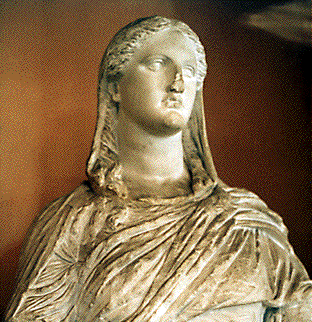
If this isn't the greatest story in the world, what is? Well, The Odyssey gets in there, and the Iliad, and Gilgamesh, and Ishtar, (a progenitor, of sorts) for starters, all come close, but nothing is like the story of Persephone. It takes abundant narrative shifts, and its protagonist practically disappears before our eyes. We barely get to know her and she's gone; when she returns she has become the Queen of the Dead, living, if it can be called that, in the Underworld. The story as we have it from the Hymn to Demeter and Ovid is more about Demeter, her mother, who is very like a witch in this story, than Persephone, known to the Latins as Proserpina, who is also called Kore, the daughter, which is the name given to all those lovely clothed feminine counterparts to the kouros.

For most, the story represents the etiology of summer and winter. Not for me. I am with those who find that explanation a bit weak. Much more satisfying to me is to understand the story of Persephone as the story of marriage in the Ancient world-marriage as rape-as presented from the mother's perspective, mourning, her torch and sickle in hand, or gnawing idly on Pelops' shoulder.

Persephone's quiet disappearance is so familiar; women in the literature of the ancient world do it so well. I think of Penelope's quiet, veiled presence in the Odyssey, so powerful, and yet almost never fully there. I think of Nausicaa in the same narrative--a character I identify with the young Penelope, by the way-whose vivid and lively presence entrances us for a few brief minutes and then is gone. I think, of course, of Sappho, smiling from the shadows.

Thursday, April 05, 2007

Phaethon

Rubens, 1636

Ovid's story of Phaethon—A summary

Phaethon, the son of Clymene, demands to know if his father is really Phoebus, the god of the sun. Some kid had been teasing him about it. She swears that he is indeed the son of Phoebus, but Phaethon must see for himself. The boy heads out to visit the Palace of the Sun God, entering and marveling at the magnificent palace. Phoebus greets him and affirms he is the boy’s father. Phoebus, to show his fatherly concerns, swears an oath--a rash promise--that he will grant his son anything he desires. Phaethon instantly says he wants to drive the chariot of the sun around the sky for one period. Phoebus instantly regrets his oath and describes the terrible hazards of the trip, should Phoebus insist. Phaethon does insist and takes the reins. As soon as the four winged horses start off, however, they can’t feel anyone in the chariot and start to run wild. The chariot is so light it starts to bounce around all over the place, and Phaethon can not hold the reins. Then a series of disasters starts all over the earth—mountains burning and rivers drying up—until Earth herself complains. Jove must intervene to save the earth from total destruction; he hurls a thunderbolt at the youth, who sails across the sky, trailing fire like a comet. The body lands far from his home and a carved stone is erected to mark the place. Clymene, his mother, seeks for his body and finds the buried bones. His sisters, the daughters of the sun, grieve for him, and in their grief turn into poplar trees. Clymene tries to prevent the transformation, tearing the bark. This hurts them, they start to bleed and ask her to stop, as their transformation becomes complete.

Some initial observations

This story starts with a kid teasing another kid about his Dad and ends with the origin of amber jewelry used by Roman brides at their weddings. These might seem minor, innocuous, innocent, and almost banal events; they frame the near destruction of the universe as the almost unimaginable comes to happen when the sun careens off course. This is a story with themes of near cataclysm—the world nearly burns up—linked to themes of ordinary family life and interaction between the generations. Phaethon’s story tells how the laws of a balanced creation are upset and then restored. This pattern can be found in other stories from Ovid’s collection—and elsewhere.

Phaethon seeks the answer to his own identity. At first it is a subject of public scorn and mockery. Then it becomes a personal quest for proof of parentage. Then it becomes taking over the father’s role when clearly unqualified and unempowered to do so. The only authority Phaethon wrests from the world derives from Phoebus’ rash and binding oath, a freely given paternal gift that becomes both punishment and death. Phoebus’ end, though, is more than death; it is destruction on a grand scale going out as a fiery comet over the entire earth. This is one blaze of glory.

Phaethon’s need to see tangible proof of his father’s identity—his own identity—is no sooner satisfied than his father’s rash promise leads to his own son’s destruction. The desire to know who you are—who your father really is—leads to Phaethon’s death. We see Phaethon with a kid his own age, with his mother, and with his father. From each he takes off to see the next, always seeking to learn and to know. Knowledge, the story suggests, may be dangerous.

The magnificent dawn palace of Phoebus is characterized by rich ornamentation and details of earth as “set in relief” by Vulcan, the god of craft and the forge. It is a model of the earth itself, and serves as a reminder that the earth, too, is a handiwork.

The father’s rash promise to the son is made out of absolute love—he wants his son to be happy and to recognize his father as such. The absolute nature of the promise, however, seals the boy’s fate (echoed in the story of Semele). Just as knowledge may be dangerous, so too may love. Out of love, then, may come destruction, and from grief, sometimes, new life arises, and new forms of being, as when the sisters become trees, the source of amber. The amber is associated with contemporary weddings and so, again, familial love.

Ovid and Art


Ovid is the one writer anyone interested in Western Art really ought to know, along with the Bible, of course. He is as great a storyteller as Homer, though in an advisedly less grand manner; he takes most of Greek and Roman mythology as his subject in The Metamorphoses. The relative amounts of pleasure we take from reading Ovid as opposed, say, to reading Virgil, must also account for the astonishing variety of artistic creations Ovid has let loose. Homer and Virgil and the rest of Greek and Roman mythology are responsible for some pretty fine illustrations, but nobody has Ovid beat. In my classes lately I have focused more on Homer, especially when I have not been able to use one of those wonderful Smart Rooms to teach with. Also, I had a bad time with Ovid in the classroom last time I brought him up.

To start, I recommend reading both the Phaethon and the Proserpina stories--finding different translations of the same story can be a useful exercise--and looking at artworks associated with the boy and the girl. Think about them as myths, as stories of a particular kind. Think about how they are similar and different, that is, compare and contrast them. See if you can find ways of describing them in terms of gendered growing-up narratives, as "what boys do" and "what girls do." Where does that get you?

Thursday, March 22, 2007

Iphigenia and Artemis


Having brought out the Oresteia, I thought of ways I might illustrate my lecture. Images of Agamemnon, however, are generally, in my experience, uninteresting. An image of the sacrifice of Iphigenia, on the other hand, ought to be a stunner. I am not all that familiar with the standard paintings-Torrelli, Fontebasso, Steen, Houbraken, Testa, Tiepolo -but they don't seem to leap off the canvas. This group, however, does capture something of the scene. This, found in Rome in the Gardens of Sallust and dating to 250-160 BCE (Hellenistic), depicts the version of the myth in which Artemis, who is after all the god of young girls--substitutes a stag for the body of the young girl at the last minute. There is nothing last-minutish about this group; time appears slowed down, and cooled off. The Artemis is a very good bodily portrait of the goddess, collected and virginal, and the graceful diagonal of the exposed Iphigenia is a worthy subject of her attentions.
They hold her over the improvised altar
Like a struggling calf.
The wind presses her long dress to her body
And flutters the skirt, and tugs at her tangled hair-- (Hughes)
The story of the sacrifice is so brazen, it seems to have acquired ambiguities along the way. What makes Artemis so angry? Why would she condone the sacrifice of one of her own? Aeschylus apparently originates the story that Agamemnon himself interprets the signs in such a way as to mean he sacrifice his daughter. I recall as a kid I much preferred the version of the stag substitute, though Aeschylus, clearly, knows better.